How to import Himalayan salt from Pakistan to the USA: a first-timer's walkthrough
Fourteen steps in the order you actually do them, written by the people at the loading end. Our shipping & import guide is the reference sheet this is the story of a first shipment, including the parts that go wrong.
- Decide what you are actually importing
- Choosing and vetting a supplier
- The sample stage, and the test you run yourself
- Getting a real quote (with an RFQ template)
- Setting up your side: broker, EIN, bond, insurance
- FDA: what we do, what you must do
- Duty and classification
- Payment terms that protect you
- Production and pre-shipment checks
- Shipping and transit time
- Arrival, clearance and the demurrage clock
- If you are selling at retail
- A realistic cost and timeline summary
- If this really is your first time, do this instead
We load salt for a living, and we have walked several dozen first-time American buyers through this sequence. The ones who do well are rarely the ones with the biggest budget. They are the ones who did steps five and six before the vessel sailed.
What follows is the process in the order you actually perform it. For the freight-mode table, Incoterm definitions and the full document set, keep the shipping & import guide open alongside this page we are not repeating it here.
1. Before you contact anyone: decide what you are importing
Three decisions, and all three change the price you will be quoted.
Food or non-food? The big fork. Edible salt drags in FDA registration, Prior Notice, a Foreign Supplier Verification plan and retail labelling law. Lamps, bath soaks, animal licks and de-icing salt sit under different rules lamps in particular are an electrical product with a cord and a US plug. Pick one lane for your first shipment. Buyers who order a mixed container of edible salt and lamps to "test the market" run two compliance processes and test neither properly.
Realistic first volume. Not the volume in your business plan. The volume you can sell in six months if the product turns out to be slightly wrong.
Budget including freight, honestly. Below about 500 kg the freight and fixed charges dominate the invoice. A 200 kg trial can land at three or four times the ex-works salt price once groupage, brokerage and handling are added. That is not a supplier ripping you off. It is arithmetic, and it does not improve until you scale.
Roughly 500 kg by LCL. Big enough that freight per kilo becomes sane, small enough that a mistake costs you a weekend rather than a quarter.
2. Choosing and vetting a supplier
Pakistan has perhaps a dozen serious salt processors and several hundred trading companies with a website and a WhatsApp number. Both can ship you salt. Only one type answers the phone in month four, when a lot runs high on insolubles.
Run these checks before you send a cent:
- Ask for the FDA food facility registration number and the registered facility name. A real exporter produces it the same day.
- Ask for a COA on laboratory letterhead with a batch number on it. A PDF of typical values with no lot reference is a marketing sheet, not a certificate.
- Ask for a video call, unannounced, at a time you choose. Say you want to see the screening line running and the bagging area. Traders find a reason to reschedule. Twice.
- Pull their import records through a trade-data service. If a company claims twenty containers a month to the USA, the bills of lading exist somewhere.
- Never pay 100% in advance. There is no order size and no discount that justifies it.
- Treat a price far below the market band as a warning, not a win. Someone quoting well under everyone else is quoting a different product, a different Incoterm, or nothing at all.
- Reverse image search their factory photos. We have found our own plant on three other companies' websites. Five minutes, and it has saved buyers five-figure losses.
Ask a technical question you already know the answer to what is the typical water-insoluble content of your fine grade, and how do you measure it. A processor answers in numbers and a method. A trader answers with adjectives.
3. The sample stage, and the test you run yourself
Ask for 1–5 kg of the exact grade and grain fraction you intend to buy, from current production, with the lot COA attached. Sample courier cost is usually chargeable and usually credited against a first order. A supplier who will not send a paid sample is telling you something.
Then run the dissolve test yourself. It takes four minutes and no equipment. Dissolve 10 g of salt in 100 ml of warm distilled water, stir until it stops dissolving, and look at the bottom of the glass. Clean salt leaves a faint trace. Under-washed salt leaves a grey-brown sediment ring and a cloudy column above it the clay and mineral fines that come out of the seam with the halite, which is exactly what the COA reports as water-insoluble matter.
Also ask for a sieve analysis: the particle size distribution for that fraction, in millimetres. Grain size is where most first orders go wrong, and a sieve report turns "coarse" from a vibe into something you can hold someone to.
4. Getting a real quote
Most enquiries we receive read: "Please send your best price for Himalayan salt." We can only answer that with a range, which helps nobody. Four things make a quote comparable.
- Grain size in millimetres, not category names. "Coarse" means 2–3 mm to one plant and 5–8 mm to another. Millimetres are not ambiguous.
- Packing format. 25 kg PP bag with food-grade liner, 50 lb bag, one-tonne tote, or retail packs under your label. This moves landed cost more than the salt price does.
- The Incoterm. FOB Karachi, CFR, CIF, DDP. Comparing an FOB number to a DDP number is not comparing anything.
- Destination port. Los Angeles and Newark are different freight markets.
Copy this, fill in the brackets, send it to everyone on your list. The replies come back comparable, and the quality of the answers sorts your shortlist for you.
Subject: RFQ Himalayan pink salt, [quantity], [port]
Please quote the following:
1. Product and grade: [edible food grade / bath / lamp / lick / industrial]
2. Grain size: [e.g. 0.3–1.0 mm], with a sieve analysis attached
3. Quantity: [e.g. 25 MT, or 500 kg]
4. Packing: [25 kg PP bag with PE food-grade liner, palletised, ISPM-15 pallets]
5. Incoterm and port: [FOB Karachi / CFR Los Angeles / CIF Newark]
6. Lead time from cleared payment
7. Payment terms you accept
8. Your FDA food facility registration number
9. A recent COA on laboratory letterhead, with the batch number
10. Whether the price includes a lot-specific COA and certificate of originPlease also confirm net weight per container you will load, and whether the quoted price is per kg or per metric ton.
5. Setting up your side
The step first-timers postpone, and the one that costs them money.
Appoint a customs broker before the vessel sails. Not when the arrival notice lands. They need your importer details, a signed power of attorney, bond information and product data on file before they can file anything, and onboarding takes days you will not have once the box is on the water. We have watched a container accrue demurrage at well over $150 a day because a signature was missing.
Get your importer number. For a US business that is normally your IRS-issued EIN; sole traders can use a CBP-assigned number. Your broker settles this in ninety seconds.
Decide on a customs bond. A single-entry bond covers one shipment and is cheaper on day one. A continuous bond covers a year of entries, costs more up front, and usually pays for itself around the third or fourth shipment while removing a per-entry task. Neither is universally right; it depends on how many entries you will file in twelve months and on your entered value. Have your broker price both against your actual plan rather than guessing from a blog post, this one included.
Buy marine insurance. Cover on a $15,000 container is a small number. Under CFR the seller pays the freight but risk passed to you on board at Karachi a detail people discover at the worst possible moment.
6. FDA obligations, split honestly
Food shipments carry three FDA-related duties, and they do not all belong to the same party. Suppliers who blur this line are doing you no favours.
| Obligation | Whose job | Timing |
|---|---|---|
| Foreign food facility registration | The exporter us | Renewed biennially, 1 October to 31 December of even-numbered years |
| FDA Prior Notice | Yours, normally filed by your broker | Every single shipment, before arrival |
| FSVP Foreign Supplier Verification Program | Yours. Legally, as importer of record. | Written plan in place before you import, kept current |
FSVP is the one that surprises people. The regulation names the importer, not the exporter. No supplier can hold it for you, and any who claims to has misread the rule. What we can do and do every week is hand your consultant the evidence the plan rests on: HACCP documentation, lot COAs, audit records and the facility registration. The file is yours to own.
7. Duty and classification
Good news, and it is genuinely good. Himalayan rock salt classifies under HTS heading 2501, US subheading 2501.00.0000, and the General (Column 1 / MFN) rate that applies to Pakistan is Free. Zero.
If a tariff lookup showed you roughly 30%, you were reading the Column 2 rate, which applies to a short list of non-NTR countries and has nothing to do with Pakistan. We field this question most months, usually from someone who has just built a spreadsheet around the wrong number.
Verify at hts.usitc.gov before every shipment anyway. Section 301, Section 232 and IEEPA-type actions can change how a line is treated independently of its base rate, and 2026 has not been a quiet year for that.
Pakistan has no free trade agreement with the United States. It does not matter here: the MFN rate is already zero, so there is nothing for a preference programme to reduce. Anyone offering GSP or FTA paperwork that will "save you the duty" on salt is selling you a discount on nothing.
8. Payment terms that protect you
Two structures cover almost every first order we handle.
30% T/T advance, 70% against a copy of the bill of lading. Simple, cheap, and standard for containerised salt. Your deposit funds production; the balance falls due only once the cargo is demonstrably on a vessel with your name on the document.
An irrevocable letter of credit at sight. More paperwork and bank fees, and worth it on a first container with a supplier you have never met. An L/C protects a first-time buyer more than it protects the seller, which is exactly why some suppliers resist one. The bank pays only against documents that match the terms you wrote the bill of lading, the packing list, the COA. Get the shipment wrong and the exporter has a discrepancy problem, not you.
No legitimate exporter needs your entire order value before production. The two most common total-loss stories we hear both start with a full advance to a company found on a marketplace listing, and both end with a phone number that no longer connects.
9. Production and pre-shipment
Production on a 20ft container runs roughly 10–18 days from cleared payment. Ask for these before the seal goes on, and ask in writing:
- Loading photographs the empty container, the pallets going in, the final stow, and the doors closed with the seal visible.
- The seal number, photographed, matching the number on your packing list and bill of lading. Three documents, one number.
- The packing list with bag and pallet counts, net and gross weight per pallet.
- The lot COA on laboratory letterhead, batch numbers matching the bags.
If your container loads between roughly July and September, ask specifically for a moisture reading on the shipped lot. Monsoon-season salt that was not dried properly cakes into a solid block somewhere around week four at sea, and a pallet of pink concrete is nobody's idea of a first order.
10. Shipping
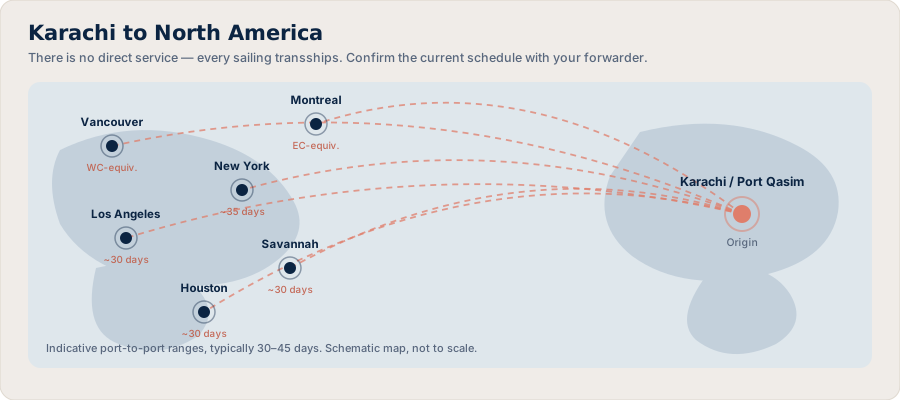
There is no direct service from Karachi to any US port. Every box is transshipped through a hub, waits for a connecting vessel, then runs the second leg. Plan on 30–45 days port to port. Indicative forwarder averages: around 35 days to New York, around 30 to Los Angeles, Houston and Savannah. Treat those as a range, not a schedule, and confirm the current figure at booking a change of transshipment hub moves the number by a week either way.
On volume: a 20ft container books 24–27 MT net of bagged, palletised salt in practice, against an engineering maximum payload near 28.2 MT. Pallets eat space and destination road-weight limits cap what a truck may legally pull.
And no, a 40ft box does not carry double. Salt is weight-limited, not cube-limited you hit the ceiling long before you fill the space. Price two 20ft containers against one 40ft before you assume the bigger box is the better deal.
11. Arrival and clearance
ISF. The Importer Security Filing must be transmitted before the cargo is laden at the foreign port in practice your broker wants the data at least a couple of days before the vessel cut-off. Late ISF filings attract penalties that make the whole exercise feel unfair.
Entry. Your broker files the customs entry and the FDA Prior Notice against the arrival. On a clean salt shipment this is routine and quick.
An FDA hold. It happens, and it is not an accusation. The shipment is held at the port while FDA reviews documents or takes a sample; you pay for storage while it sits. Clean paperwork and a lot-specific COA already on file is what turns a hold from two weeks into two days.
Demurrage and detention are different things, and the difference costs money. Demurrage accrues at the terminal while your container sits inside the port past its free days. Detention accrues after the container leaves the terminal and you are still holding the box, unloaded, on your yard. Free time is typically a handful of days for each and both run into three figures a day. Know your free days before the vessel arrives.
Devanning is unloading the container. Bagged palletised salt comes out with a forklift in under an hour. Loose-loaded bags come out by hand, take most of a day, and are the reason we palletise by default.
12. If you are selling at retail
This is the step that catches people after everything else went right, which is what makes it so expensive.
Under 21 CFR 100.155, salt sold at retail without added iodide must carry the statement "This salt does not supply iodide, a necessary nutrient" immediately after the product name, in type at least as large as the net quantity declaration. Pink salt has no meaningful natural iodine, so this applies to essentially every retail pack we ship. You also need a Nutrition Facts panel per 21 CFR 101.9. Packages under half an ounce are exempt from the iodide statement.
We have watched a buyer hand-apply corrective stickers to 38,000 grinder jars in a rented warehouse because the artwork went to print without the iodide line. The rule costs nothing to follow and a fortune to retrofit. Have the artwork checked before the print run, and treat the type-size clause as seriously as the wording.
13. What a first 20ft container really costs and takes
Indicative figures for roughly 25 MT of bagged edible salt, August 2026, one buyer's realistic range rather than a quotation. Freight is the volatile line.
| Line item | Indicative range | Notes |
|---|---|---|
| Salt, ex-works, ~25 MT | $12,000–$18,000 | Grade and grain dependent |
| Inland haulage + export clearance | Included in FOB | Seller's cost under FOB Karachi |
| Ocean freight, Karachi to US port | $1,800–$4,500 | Highly variable; quote at booking |
| Marine insurance | $60–$180 | Roughly 0.3–0.8% of CIF value |
| US customs duty, HTS 2501.00.0000 | $0 | MFN rate Free |
| Customs brokerage + ISF + Prior Notice | $150–$400 | Per entry |
| Customs bond | $60–$600 | Single-entry vs continuous ask your broker |
| Terminal handling + drayage | $600–$1,400 | Distance from port drives this |
| Devanning | $150–$450 | Palletised is fast; loose-loaded is not |
| Indicative landed total | $14,800–$25,500 | Roughly $0.59–$1.02 per kg landed |
On the calendar: 1–2 days to a written quote, 2–4 to clear the proforma, 10–18 for production and documents, 3–6 for haulage and vessel cut-off, 30–45 at sea, and 2–5 for entry and release, plus drayage. Call it eight to twelve weeks door to door, and add broker onboarding and FSVP preparation for a genuine first shipment. Three months is a sane plan. Nobody makes up time in ocean transit; the only days you control are the first ten.
14. If this is your first time, do this instead
Buy 500 kg by LCL.
Seriously. It costs more per kilo than a container and it is still the best money you will spend. You run the same process end to end broker, bond, ISF, Prior Notice, FSVP, entry, release, devanning with a fraction of the capital at risk and a supplier relationship that has been tested by something real rather than by email. You will discover what your customers think of the grain size before you own 25 tonnes of it. You will find out whether your broker returns calls. You will learn what your warehouse actually charges to receive a pallet.
Then order the container, from a supplier who has already shipped you something, with a document set you have already seen work.
The shipping & import guide has the freight-mode table, Incoterm comparison and full document list. Small orders covers how a 25 kg or 500 kg trial actually works. Wholesale pricing publishes the price bands behind the table above.
First-time importer questions
Budget roughly $13,000–$21,000 landed for a 20ft container of about 25 MT of bagged edible salt, with the wider outside range in the table above. The salt is usually 55–65% of it; freight, handling, brokerage and drayage make up the rest. Duty is zero. Add one-off costs a repeat importer will not pay again: bond, first FSVP plan, broker onboarding.
An EIN or CBP-assigned importer number, a customs bond, a broker holding your power of attorney, FDA Prior Notice filed for each shipment, and a written FSVP plan that you hold. We hold the foreign facility registration and supply the HACCP file, COAs and audit records your plan rests on but the plan is legally yours, not ours.
Yes. HTS 2501.00.0000, General (Column 1 / MFN) rate Free. The ~30% some lookup tools display is the Column 2 rate for non-NTR countries and does not apply to Pakistan. Check hts.usitc.gov before each shipment regardless Section 301, 232 and IEEPA-type actions can change treatment independently of the base rate.
Eight to twelve weeks realistically, of which 30–45 days is ocean transit (every Karachi sailing is transshipped: ~35 days to New York, ~30 to LA, Houston and Savannah as indicative averages). For a genuine first shipment, add broker onboarding and FSVP preparation and plan on three months.
No. Start at about 500 kg by LCL. It is the smallest quantity where freight stops dominating, it is enough for a real production run and a shelf test, and it runs you through the identical customs and FDA routine at a tenth of the exposure. Order the container second.
Send us a spec — we quote within one working day
Tell us the grade, grain size, packing and destination port. You get a written quotation, a specification sheet, and a sample on its way the same week. Trial orders start at 25 kg.