Himalayan bath & spa salt, plain by the bag or blended under your label
Four calibrated grain fractions for soaks, scrubs, bath bombs and foot baths. Plain unscented from a single 25 kg bag; fragrance, colour, botanical and carrier-oil blends from 500 kg. Ingredient documentation, CoA and IFRA certificate with every blended lot.
Grain size matters here, but not for the reason it does in food
In edible salt, grain size governs dosing and dissolve rate. In bath salt it mostly governs what the product looks like through glass. Buyers get this wrong constantly they order fine because it sounds premium, then find their jar looks like table salt beside a competitor's chunky pink rock.
Fine 0.3 to 1.0 mm
Scrubs, emulsified scrubs and bath bombs anything that must stay suspended in oil rather than settling out. For bath bomb work it needs to be dry: damp salt triggers the citric acid reaction in the mould.
Medium 1.0 to 2.0 mm
The general soak grade and our highest-volume bath line. Sane dissolve rate, holds fragrance, pours cleanly from a pouch. No strong opinion? This is it.
Coarse 2.0 to 5.0 mm
Where the visual argument starts. Coarse reads as hand-mined through a clear jar. It also dissolves slowly, which some customers read as value and others as grit at the end of the bath.
Extra coarse 5.0 to 8.0 mm
Foot soaks and display-led jar fills; slow dissolve is an advantage in a foot bath. Mind the density trap a 500 ml jar of extra coarse holds noticeably less by weight than one of fine.
Chunks 10 mm and up
Display jars, gift sets, treatment-room props. From 500 kg, because hand-sorting chunks is slow work.
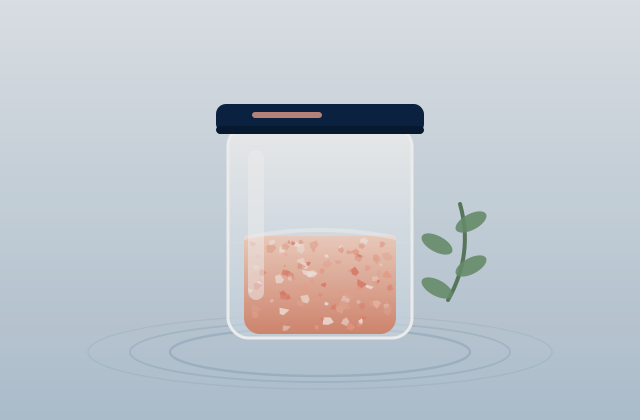
Post us the empty container you plan to fill and we will give you the real fill weight for each fraction before you print a net-weight claim.
Two different businesses wearing the same name
Plain bath salt is a commodity. Blended bath salt is manufacturing. Price, minimum order and lead time all follow from that.
Plain, unscented, uncoloured
Washed, dried, screened, bagged, straight off the same line as everything else we make so a 25 kg minimum costs us nothing. Buyers taking plain are blending themselves, pressing bath bombs, running a spa, or selling a single-ingredient clean-label product. Margins are thin, and the real differences between suppliers are washing quality, insolubles, and whether the liner survives the voyage.
Blended
Fragrance or essential oil, colourant, dried botanicals, carrier oil, or a combination. Minimum 500 kg per SKU per scent. Not obstinacy: a run means setting up the ribbon blender, dosing, then a full cleandown so the next customer's lavender does not arrive smelling of eucalyptus. That work costs the same at 100 kg as at two tonnes.
Fragrance load, in real numbers
Bath salt in this trade typically runs 0.5% to 2% fragrance by weight. Under 0.5% the scent is gone by the time the jar reaches a shelf. Over about 2% you fight physics: oil coats the crystal, the crystal stops flowing, and six months later your customer has a scented brick. Essential oils are harder work many are volatile, so you dose higher for a perceptible scent at point of sale.
Colour is underestimated even more often. Cosmetic dye migrates as the carrier evaporates, so a jar that left us an even blush can arrive with a darker band at the bottom, and it fades under shop lighting. Blunt advice: unless colour is central to your brand, go dye-free. The natural pink is already the main visual asset, dye-free sells far more easily to clean-beauty buyers, and it removes a whole class of complaint.
Lavender buds and rose petals photograph beautifully and cause two problems. They float, then block a drain, which generates returns. And they are agricultural material with their own microbiological profile going into a cosmetic. We will blend them and point out that a muslin infuser pouch solves both for a few cents a unit.
What we can tell you, and where your advisor takes over
Bath salt sold for soaking is generally regulated in the United States as a cosmetic rather than a drug, provided the marketing stays on the cosmetic side of the line. That line is drawn by claims, not ingredients. "Scented soak" is comfortably cosmetic. "Relieves eczema", "treats arthritis" or "detoxifies" are claims about treating disease or altering the body's structure or function, and can push the same jar of salt into drug territory. We raise it because we see the copy.
MoCRA, the Modernization of Cosmetics Regulation Act, introduced obligations including cosmetic facility registration and product listing for the US market. Our understanding stated plainly, and not as your counsel is that these attach to the US brand owner or responsible person named on the label, rather than to an overseas ingredient supplier. Requirements, small-business exemptions and enforcement timelines have moved since the Act passed. Confirm your position with your regulatory advisor before you launch. What we supply as standard:
- INCI name: Sodium Chloride. Note carefully Maris Sal is the INCI designation for sea salt. Himalayan is mined rock salt, so Maris Sal is the wrong name and we will not put it on a document.
- Certificate of analysis per lot, on the laboratory's letterhead, carrying the batch number printed on your bags.
- Fragrance allergen declaration in the EU 26-allergen format, from the fragrance house.
- IFRA conformity certificate stating category and maximum use level.
- SDS, specification sheet and a no-animal-testing declaration.
Our documentation supports your compliance work. It does not replace it, and any supplier saying otherwise is not being straight with you.
Send draft label copy with your first order and we will flag anything that reads like a drug claim. We are not lawyers, just people who have read a great many bath salt labels.
Indicative bands, published
Ex-works US dollars, August 2026, plain cosmetic-grade salt in 25 kg lined bags. Freight, insurance and duty quoted separately. Indicative, not a binding offer.
| Order size | Fine | Medium / coarse | Extra coarse / chunks | Typical buyer |
|---|---|---|---|---|
| 25–100 kg | $1.90–$2.15 / kg | $1.80–$2.05 / kg | $1.75–$2.00 / kg | Formulation trial, single spa |
| 100–500 kg | $1.35–$1.65 / kg | $1.28–$1.58 / kg | $1.22–$1.52 / kg | First production run |
| 500 kg – 5 MT | $1.10–$1.35 / kg | $1.04–$1.28 / kg | $0.98–$1.22 / kg | Established brand, LCL pallets |
| 5–20 MT | $0.92–$1.12 / kg | $0.88–$1.06 / kg | $0.82–$1.00 / kg | Part container, groupage |
| Full 20ft container | $0.78–$0.95 / kg | $0.74–$0.90 / kg | $0.70–$0.86 / kg | Repacker, contract filler |
Blending premiums and specialist lines
| Line | Indicative price | MOQ | Notes |
|---|---|---|---|
| Fragrance only (0.5–1%) | + $0.35–$0.60 / kg | 500 kg | Premium on top of the plain band above |
| Fragrance + cosmetic colour | + $0.45–$0.80 / kg | 500 kg | Migration and fade risk see above |
| Essential oil blend | + $0.70–$1.60 / kg | 500 kg | Driven by the oil; rose absolute is not lavender |
| Botanical inclusion | + $0.55–$1.25 / kg | 500 kg | Lavender, rose petal, calendula, chamomile |
| Salt scrub base (fine + 8–15% carrier oil) | $2.10–$2.60 / kg | 500 kg | Almond, fractionated coconut, grapeseed. The oil sets shelf life, not the salt |
| Bath bomb grade (fine, unscented, low moisture) | $0.95–$1.40 / kg | 25 kg | Extra drying step; moisture stated on the CoA |
Terms and a worked landed-cost example on the pricing page.
What actually leaves our floor
Roughly in order of volume, because the order surprises people.
Bath soak retail packs jars and pouches, 200 g to 1 kg, medium or coarse, usually fragranced. The bulk of the private-label work.
Bath bomb manufacturing input fine, unscented, low moisture, 25 kg bags, fragranced downstream. Steady repeat volume, no drama.
Salt scrub base fine salt pre-blended with carrier oil, sold on to brands filling their own jars.
Foot soak extra coarse, often peppermint or tea tree, to podiatry and nail-salon distributors.
Spa treatment-room bulk 25 kg bags into back-of-house scrubs and hydrotherapy. Price-sensitive, plain, high repeat.
Hotel amenity sachets and 50 g pouches, tight cost targets, and procurement teams who want documentation before a sample.
Subscription box fills seasonal, with volumes that swing hard. Send your calendar early and we will hold stock.
Salt plus humidity equals one solid brick
That is the whole packaging conversation; the rest is detail. Salt is hygroscopic. Give it moist air and it recrystallises into a lump that needs a mallet, and your customer photographs it.
So: 25 kg PP bags with a heat-sealed food-grade PE liner, even though nobody is eating this. Food-grade liner is simply the spec that seals reliably. We pack at ambient temperature rather than off the dryer, because warm salt sealed in a bag sweats in transit.
PET jars are lighter, cheaper to freight and do not arrive in pieces the e-commerce default. Glass feels better on a shelf and adds freight and breakage.
Kraft pouches with a window have taken much of the mid-market: cheap, they show the pink, they ship flat. Insist on a proper moisture barrier layer, because a weak-barrier pouch is where the brick problem appears first.
Desiccant sachets cost a few cents and prevent most humidity complaints. For anything crossing the equator or warehoused on the Gulf Coast in summer, put them in.
How a private-label bath salt project actually runs
Brief to goods on the water is usually 10 to 14 weeks, and the delays are rarely at our end they are artwork approval and fragrance indecision.
Brief days 1–3
Grain fraction, scent direction, colour or not, pack format, target retail price, volume. Post us a competitor product if you have one.
Shortlist & samples days 4–18
Three to five scents shortlisted with the fragrance house, three lab samples blended at 1–2 kg each and couriered. Allow 10 to 14 days from brief to samples in hand, transit included.
Approval & artwork days 19–40
You pick a scent, we confirm fragrance load and IFRA category, artwork goes to proof. This is where projects stall: two rounds is normal, five is common and costs three weeks.
Pilot & production days 41–80
A 500 kg pilot, shipped as sellable stock, before any container commitment. Production is 18 to 25 working days after sign-off, plus sailing.
Every buyer who skipped it and went straight to a container regretted at least one decision usually the fragrance load.
Himalayan vs Epsom vs Dead Sea, without the marketing
These get compared as though they were three versions of one thing. They are different chemicals. Epsom salt is magnesium sulfate and contains no sodium chloride at all: cheap, colourless, quick to dissolve. Dead Sea salt is a mixed mineral salt, high in magnesium and potassium chlorides alongside sodium chloride, variable by harvest and the most expensive of the three. Himalayan salt is mined halite, typically 97–99% sodium chloride, with trace iron oxide producing the pink a real trace mineral content, in quantities far too small to do anything measurable in a bathtub of water.
Which brings us to the claim that will not die. Transdermal magnesium absorption from bath soaks is not well supported by the available evidence; the published work is thin, and much of it small or industry-funded. That is more an Epsom claim than ours, but the halo drifts across the category and we would rather not stand under it.
We sell on three things: it looks better in a jar than anything else in the category, the coarse fractions give a texture customers read as natural, and it costs a fraction of Dead Sea salt. If a supplier is selling you medical benefit, ask for the study.
Bath salt questions we get every week
Fine, 0.3 to 1.0 mm, and specify low moisture. Bath bomb mixes react to water, so damp salt will set the batch off in the mould. Ask for the moisture figure on the CoA and keep the salt in its sealed liner until the day you press.
Plain comes straight off the screening line, so one bag costs us nothing extra. A blend means setting up the blender, dosing fragrance, running, then a full cleandown so the next customer's product is not contaminated. That is roughly a shift of work whether we run 100 kg or two tonnes.
Yes, and for many small brands it is the better route. Buy plain at commodity price, blend to your own recipe in your own space, and change fragrance without a 500 kg commitment each time. We still supply the INCI statement and CoA for the salt.
For the salt: INCI name Sodium Chloride, a lot-specific certificate of analysis, a specification sheet and a non-animal-testing declaration. For blended lots: the IFRA conformity certificate, an allergen declaration in the EU 26-allergen format, and the SDS. We are the ingredient and blending supplier, not the responsible person under MoCRA registration and product listing obligations sit with the US brand owner on the label. Confirm your position with your regulatory advisor.
Moisture, nearly always. A punctured liner, or salt packed slightly warm that then sweated in a container crossing the tropics. Heavy oil loading makes it worse. Fixes: heat-sealed food-grade liner, ambient-temperature packing, desiccant in the retail pack, and total oil and fragrance under roughly 2% by weight.
Different chemicals. Epsom is magnesium sulfate; Himalayan is 97 to 99% sodium chloride with trace iron oxide for the colour. Claims about magnesium crossing the skin during a soak are not well supported by evidence, so we do not sell on that. Himalayan wins on appearance, texture and cost against Dead Sea salt.
Yes PET and glass jars, kraft pouches with or without a window, and cartons. Send print-ready artwork or we can arrange design. Filled retail packs carry the same 500 kg blended minimum by salt weight. See private label for pack specifications and artwork templates.
Send us a spec — we quote within one working day
Tell us the grade, grain size, packing and destination port. You get a written quotation, a specification sheet, and a sample on its way the same week. Trial orders start at 25 kg.