The salt lamp wholesale business, with honest numbers
Salt lamps look like an easy import business. Low unit cost, high perceived value, evergreen demand. The arithmetic is less friendly than that, and the two things that sink most sellers are not on any listing-research tool.
1. Why the business looks attractive
A 2–3 kg natural salt lamp costs a few dollars to buy at volume and retails between $18 and $30 in the United States. That gap is what draws people in, and it is real. Demand is genuinely evergreen, spikes hard in Q4, and the product photographs well.
We ship these by the container. We also watch a steady stream of new sellers order 500 pieces, sell them, run the numbers properly, and never order again. This article is the arithmetic we send them before they order, because a customer who understands the margin buys for years and a customer who doesn't buys once.
2. The real unit economics
Take the most common entry point: a natural 2–3 kg lamp on a wooden base with a certified cord set, ordered at 1,000 pieces, shipped by sea to a US East Coast port.
| Line item | Basis | Per lamp |
|---|---|---|
| Lamp ex-works | 1,000 pcs band, mid-range | $4.65 |
| Certified cord set | UL/ETL, included in our price | — |
| Retail carton, hang tag, leaflet | Branded | $0.95 |
| Master carton & palletisation | 6 lamps per master | $0.22 |
| Inland haulage & export charges | Share per lamp | $0.18 |
| Ocean freight (LCL at this volume) | ~3.4 kg gross per packed lamp | $1.05–$1.60 |
| Customs brokerage & entry | Share per lamp | $0.14 |
| Drayage & devanning | Share per lamp | $0.21 |
| Landed cost | Delivered to your warehouse | $7.40–$7.95 |
That is before you have sold anything, before storage, and before a single return. At a full container the same lamp lands closer to $5.80–$6.40, which is why volume matters more here than in almost any other salt line.
People budget the ex-works price and treat freight as a rounding error. On lamps it is 15–25% of landed cost at LCL volumes. A lamp quoted at $4.65 does not land at $5.
3. Freight, and why lamps are the worst case
Bulk salt is weight-limited: you fill a 20ft container to 24–27 metric tons and run out of weight long before cube. Lamps are the opposite problem in the worst way they are both heavy and bulky, because each one needs a carton with void fill around it. You pay for the air.
Rough planning figures for packed lamps in a 20ft container:
| Lamp weight band | Packed gross each | Approx. pieces per 20ft | Limiting factor |
|---|---|---|---|
| 1–2 kg | ~2.4 kg | 4,000–5,000 | Cube |
| 2–3 kg | ~3.4 kg | 3,200–3,800 | Cube |
| 3–5 kg | ~5.2 kg | 2,400–2,900 | Cube then weight |
| 5–7 kg | ~7.6 kg | 1,900–2,300 | Weight |
| 7–10 kg | ~11 kg | 1,400–1,700 | Weight |
Air freight is available and almost never worth it. Charged on chargeable weight, a lamp that costs $4.65 to make can cost $9 to fly. We will quote it if you are rescuing a Q4 stockout, and we will tell you it is a bad idea first.
4. The cord problem that delists sellers
This is the single most important section on this page, and it has nothing to do with salt.
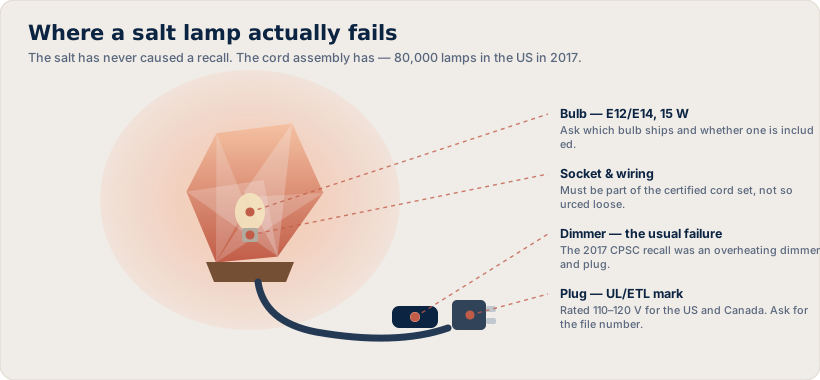
In January 2017 the US Consumer Product Safety Commission announced a recall of approximately 80,000 "Lumière" brand rock salt lamps sold at Michaels stores. The reason: the dimmer switch and/or the outlet plug could overheat and ignite, presenting shock and fire hazards. The lamps were manufactured in Pakistan. The remedy was a full refund.
Nothing about that recall was caused by the salt. It was the electrical assembly specifically the cheapest, most-substituted component in the whole product. A cord set with a certified plug, a certified socket and a properly rated dimmer costs perhaps sixty to ninety cents more than an uncertified one. That difference is exactly where a supplier quoting you 20% below the market band is finding the money.
Not "is your lamp UL certified" the lamp as an assembly usually is not, and a supplier saying yes may be describing the cord. Ask for the cord set certificate: the UL or ETL file number, the component manufacturer's name, the voltage rating, and the socket type. Then check the certificate covers 110–120V for the US and Canada, not 220V.
Also worth specifying: bulb type (E12 or E14 candelabra, 15W is standard), whether a bulb is included, cord length, cord colour, and whether the dimmer is inline or in the plug. Inline dimmers fail less often in our experience, and they are easier to replace if one does.
5. Weeping, breakage and returns
Two support problems account for most salt lamp returns, and both are predictable.
Weeping
Salt is hygroscopic. In humid air the surface pulls moisture and the lamp sweats, sometimes enough to leave a ring on furniture or corrode the base. This is physics, not a defect, and the fix is simply keeping the bulb on so the surface stays warm. Customers who are told this in the box treat it as normal. Customers who are not told open a return.
The same applies to your warehouse. Lamps stored through a humid summer in an uncontrolled unit will stain shelving and soften cartons. If you are holding stock in Florida, Texas or the Gulf Coast, budget for a dehumidifier or shrink-wrap with desiccant and choose marble or onyx bases over untreated timber, which stains and swells.
Breakage
Ours run under 1.5% in transit with double-wall cartons and foam corners, and we credit anything above 2%. Yours will be higher than that after the last mile, because a parcel carrier handles a 3 kg rock very differently from a container. Budget 3–5% total loss on a direct-to-consumer model, and more on carved shapes obelisks and pyramids chip at the tip more than anything else we ship.
Sellers we work with report 4–8% on lamps sold online, against 1–2% for bulk edible salt. The gap is almost entirely breakage plus unexplained weeping. Printing a two-line care note on the carton is the cheapest margin improvement available to you.
6. Three business models compared
The same lamp, three routes to market, using the $7.65 landed cost from section 2.
| Amazon FBA | Own site (DTC) | Wholesale to retail | |
|---|---|---|---|
| Selling price | $21.99 | $24.99 | $13.50 |
| Landed cost | $7.65 | $7.65 | $7.65 |
| Platform / referral fee | $3.30 (15%) | $0.95 (payment) | — |
| Fulfilment | $6.20–$8.40 (size tier) | $7.50–$11.00 shipping | $0.60 (pallet out) |
| Storage | $0.35–$0.90 | $0.25 | $0.25 |
| Returns & breakage allowance | $1.30 (6%) | $1.55 (7%) | $0.35 (2.5%) |
| Ad spend / customer acquisition | $2.20–$4.00 | $4.00–$8.00 | $0.40 |
| Contribution per lamp | -$0.01 to $2.99 | $0.29 to $5.09 | $4.25 |
Read that FBA column again. On an entry-level lamp at $21.99, with average ad spend and a size tier that punishes heavy items, you can land on approximately zero. This is not a criticism of Amazon it is what happens when a heavy, fragile, low-priced commodity meets weight-based fulfilment fees in a category with thousands of listings.
What works better, consistently, among the sellers we supply:
- Higher weight bands. A 5–7 kg lamp costs roughly 60% more to land and sells for roughly double. The fee structure does not scale as fast as the price.
- Gift sets. Two small lamps, a tealight holder and a box at $39.99 carries the fees far better than one lamp at $21.99, and Q4 does the selling for you.
- USB and night lights. Light, cheap to ship, no mains plug certification headache, and an impulse price point under $15.
- Wholesale rather than retail. Lower price, far lower cost to serve, no returns problem, and no ad spend. Contribution per unit is often better than FBA.
7. What you cannot say on the box
Salt lamps are marketed almost universally on air purification and negative ion claims. There is no good evidence a salt lamp meaningfully cleans room air, and we will not print those claims on packaging we produce. Neither should you, and not only for ethical reasons unsupported health claims are an enforcement risk and a competitor-complaint route to getting a listing pulled.
What you can sell on, honestly and effectively: the quality of the light, warmth and ambience, the craft of a hand-cut natural object, the geology of a 500-million-year-old evaporite deposit, gifting, and interior design. Those are true, they are differentiating, and nobody has to take them down.
8. So is the margin there?
Yes, conditionally. It is there at container volume, in the higher weight bands, in gift formats, and in wholesale channels. It is thin to nonexistent on entry-level single lamps sold on a crowded marketplace with paid traffic.
Our own view, from watching this for years: the sellers who do well are the ones who treat lamps as one line inside a wider salt offering lamps, blocks, bath salt, gift sets rather than as a standalone business. The freight economics improve when you fill a container across product lines, the Q4 spike gets less terrifying, and one bad lamp season does not end the company.
If you want to test that thesis cheaply, our lamp minimum is 50 mixed pieces and a 25 kg starter box includes one lamp alongside blocks and bath salt. Prices for every format are on the pricing page.
Questions
Indicatively $3.20–$4.10 per piece at container volume for a natural 2–3 kg lamp with a certified cord, rising to $5.20–$6.40 at 50–300 pieces. Carved shapes are two to three times a natural lamp of the same weight because they are hand-worked. Full bands are on the pricing page.
The cord set, plug and dimmer should carry UL or ETL certification from an OSHA-recognised testing laboratory. Ask for the cord set's file number and component manufacturer, and confirm it is rated for 110–120V. The 2017 CPSC recall of around 80,000 rock salt lamps was an overheating dimmer and plug, not a salt problem.
Because salt absorbs moisture from humid air. Keep the bulb on, keep it off a bare wood surface, and it stops. Print that on the carton and your return rate drops noticeably.
Under 1.5% in ocean transit with proper cartons, which we credit above 2%. Add another 2–3% for parcel-carrier last mile if you sell direct to consumers, and more on carved shapes with points.
By unit volume, 2–3 kg. By profit, 5–7 kg and gift sets. The entry-level size is the one everyone lists and the one where price competition is worst.
Not as a standalone lamp order, but the 25 kg mixed starter box includes a lamp, a cooking block, wall bricks and three salt grades, which is a cheaper way to see the quality across the range before committing. Details on small orders.
Send us a spec — we quote within one working day
Tell us the grade, grain size, packing and destination port. You get a written quotation, a specification sheet, and a sample on its way the same week. Trial orders start at 25 kg.