Edible Himalayan pink salt, from a single 25 kg bag to a full container
Six calibrated grain fractions, 97–99% sodium chloride on a dry basis, no anti-caking agents, and a third-party lab report attached to every lot. Packed in 25 kg bags, 50 lb bags, one-tonne totes or under your own label.
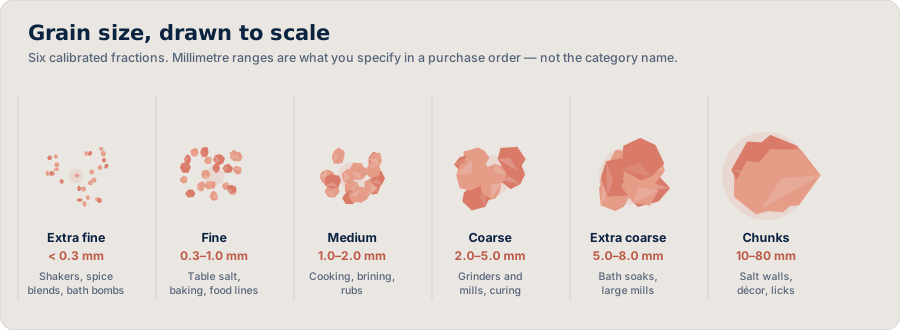
Six fractions, and what each one is really for
Most order mistakes we see are grain-size mistakes. A customer orders "coarse" expecting grinder fill and receives 5 mm rock that jams the mill; another orders "fine" for a shaker and gets 0.9 mm that pours like gravel. The category names are trade convention with no binding standard behind them, so we publish millimetre ranges and we screen to them.
Extra fine / powder under 0.3 mm
Behaves like table salt out of a shaker. Used for spice blends, seasoning mixes, bath bombs and cosmetic bases. It is also the fraction most prone to caking in humid warehouses, so if you are storing in Florida or the Gulf Coast in summer, ask us about the liner spec before you order a pallet.
Fine 0.3 to 1.0 mm
Our highest-volume grade by a wide margin. This is the workhorse for retail table salt, baking, and food-manufacturing lines that dose by weight. If you are unsure what to order and you are packing for consumers, this is almost certainly it.
Medium 1.0 to 2.0 mm
General cooking and brining. Popular with butchers, picklers and anyone building a seasoning rub who wants the salt visible in the mix. Dissolves noticeably slower than fine, which is the point in a brine.
Coarse 2.0 to 5.0 mm
Grinder and mill fill, finishing salt, and curing. If you are filling a specific grinder body, send us the model number. We keep a shelf of common mechanisms and will run a sample through yours before you commit to 500 kg, because grinder compatibility is the single most common private-label complaint in this category.
Extra coarse 5.0 to 8.0 mm
Bath soaks, decorative jar fills, large-format mills and some display uses. Slower to dissolve, visually chunky, and the fraction most buyers underestimate the weight of a 500 ml jar of extra coarse holds a lot less salt than the same jar of fine.
Chunks and rock 10 to 80 mm
Not really an edible grade in practice, though it is food-grade material. Used for salt walls, display bowls, sole jars and hand-broken applications. Sold by the 25 kg bag or bulk bag with a 500 kg minimum because sorting chunks is slow work.
A sieve analysis (particle size distribution) for the exact fraction you are considering, at no charge. Send us the mesh specification your line runs to and we will tell you honestly whether our screening hits it.
Indicative price bands, published
These are ex-works bands in US dollars for August 2026, for plain unpackaged salt in 25 kg bags. Freight, insurance and duty are quoted separately. They are indicative, not a binding offer but they are real, and they are more than any competitor site publishes.
| Order size | Extra fine / fine | Medium / coarse | Extra coarse / rock | Typical buyer |
|---|---|---|---|---|
| 25–100 kg | $1.55–$1.80 / kg | $1.50–$1.75 / kg | $1.40–$1.65 / kg | Trial order, recipe development |
| 100–500 kg | $1.10–$1.40 / kg | $1.05–$1.35 / kg | $0.95–$1.25 / kg | Small brand first production run |
| 500 kg – 5 MT | $0.85–$1.10 / kg | $0.80–$1.05 / kg | $0.72–$0.95 / kg | Established brand, LCL pallet |
| 5–20 MT | $0.68–$0.88 / kg | $0.64–$0.84 / kg | $0.58–$0.76 / kg | Part container / groupage |
| Full 20ft container | $0.55–$0.72 / kg | $0.52–$0.68 / kg | $0.48–$0.62 / kg | Distributor, repacker, food plant |
Retail-ready packing, tighter sieve tolerance, colour sorting for uniform pink, microbiological testing on every lot, small pack sizes, air freight, DDP terms, and any private-label component.
Standard 25 kg or 50 lb bags, wider grain tolerance, accepting natural colour variation, full container loads, FOB Karachi terms, and a repeat schedule we can plan production around.
See the full pricing page for every product line, a worked landed-cost example for a US importer, and payment terms.
Typical edible-grade analysis
Every lot ships with its own certificate of analysis on the laboratory's letterhead, carrying the batch number printed on your bags. The figures below are typical ranges, not the contents of your specific shipment.
| Sodium chloride, dry basis | 97.0–99.0% |
| Moisture, LOD 110 °C | ≤ 0.5% |
| Matter insoluble in water | ≤ 0.8% |
| Lead (Pb) | ≤ 2.0 mg/kg |
| Arsenic (As) | ≤ 0.5 mg/kg |
| Cadmium (Cd) | ≤ 0.5 mg/kg |
| Mercury (Hg) | ≤ 0.1 mg/kg |
| Copper (Cu) | ≤ 2.0 mg/kg |
| Anti-caking agent | None added |
| Iodine | None added |
| Allergens / GMO | None / not applicable |
| Shelf life | Indefinite in dry storage |
What these figures mean when a buyer's QA team reads them
The 97% floor matters. The Codex standard for food-grade salt sets a minimum of 97% NaCl on a dry basis. Hand-mined pink salt typically lands between 96% and 99%, which means the lower end of the natural range sits right at the line. Anyone quoting you 99.9% is describing a refined, recrystallised product which is a perfectly good product, but it is not hand-mined rock salt and it will not look like it.
Insolubles are where cheap salt shows up. Water insolubles are the clay and mineral fines that come out of the seam with the halite. Under-washed salt runs high, leaves sediment in a brine, and clouds a dissolving test. It is the fastest bench test a buyer can run: dissolve 10 g in 100 ml of warm distilled water and look at the bottom of the glass.
Heavy metal limits are not a US legal standard. This is worth understanding clearly. The United States does not set a single codified heavy-metal limit specific to salt. The values you see quoted across the industry are typical buyer specifications and Codex-adjacent reference points. Your own internal spec, or your retailer's, is what actually governs so send us your limits and we will tell you whether we meet them rather than quoting our own and hoping they line up.
Microplastics and heavy metals are a live topic. Consumer-facing coverage of contaminants in sea and rock salt has grown, and buyers increasingly ask. We would rather you asked us with a test report in hand than read something alarming and quietly move on. Ask for the full panel and we will run it.
Choose the format before you choose the price
The packing decision drives your landed cost more than the salt price does, especially under 5 metric tons.
| Format | Net weight | Best for | Notes |
|---|---|---|---|
| Courier carton | 5 / 10 / 25 kg | Samples, recipe development, trial runs | Ships DHL or FedEx, 3–6 days to most US and Canadian addresses |
| PP bag + PE liner | 25 kg | Standard bulk, food plants, repackers | Our default. Liner is food-contact grade, heat-sealed |
| PP bag, US size | 50 lb / 22.7 kg | US distributors selling by the bag | Same liner, imperial weight printed on the bag |
| FIBC tote | 1,000–1,250 kg | Plants with tote-handling equipment | Cheapest per kilo; you need a forklift and a discharge station |
| Private-label retail | 200 g – 5 kg | Grocery, e-commerce, gift | Pouches, jars, grinders, shakers see private label |
Edible salt questions we get every week
Coarse, 2 to 5 mm, is the standard grinder fill. Below 2 mm the grain falls through most ceramic mechanisms without being cut; above 5 mm it jams cheaper grinders. Send us your grinder model and we will run a sample through it before you commit to a production quantity.
No. Pink salt contains no meaningful natural iodine and we do not fortify it unless asked. If you sell at retail in the United States, 21 CFR 100.155 requires the statement "This salt does not supply iodide, a necessary nutrient" on the label, in a type size at least as large as the net-quantity declaration. We will build that into your artwork.
No, and it is stated explicitly on the specification sheet. If your filling line needs a free-flow additive we will quote it as a separate, clearly declared product. Adding one quietly would fail an audit and lose us the account.
Around 24 to 27 metric tons net of bagged salt in practice. The container's engineering maximum is about 28.2 MT, but pallet configuration and destination road-weight limits pull the bookable figure down. Because salt is dense, a 40ft box rarely carries double you hit the weight ceiling long before the cube.
Sodium chloride does not spoil. Stored dry and sealed, it keeps indefinitely. Retail packs usually carry a printed best-before of three to five years, which is a packaging and moisture-pickup limit rather than a property of the salt.
Usually, if you send us a physical sample of what you are currently buying rather than a photograph. Colour matching is done by sorting and blending, and there is a practical limit natural rock varies. We will tell you before you order whether we can hold your target within a tolerance you can live with.
No, and neither does anyone else honestly. Salt is a mineral, not an agricultural product, so it falls outside organic certification schemes in most jurisdictions. Suppliers advertising "organic Himalayan salt" are usually referring to a certified organic facility handling it, or to nothing at all. Kosher and Halal certification are meaningful here; organic is not.
Send us a spec — we quote within one working day
Tell us the grade, grain size, packing and destination port. You get a written quotation, a specification sheet, and a sample on its way the same week. Trial orders start at 25 kg.