Importing Himalayan salt from Pakistan into the USA and Canada
Most supplier sites hide this in a blog post and skip Canada entirely. This is the whole process — freight modes, HS codes, FDA and CFIA obligations, documents, Incoterms and realistic day counts — written so you can run your first shipment without paying for the education twice.
Four ways salt moves, and the weight at which each stops making sense
Salt is heavy, cheap per kilo and rarely urgent. That combination picks the mode for you. Get it wrong and the freight bill overtakes the cargo value.
| Mode | Sensible weight range | Transit | Where it breaks down |
|---|---|---|---|
| Courier DHL, FedEx | Up to about 100 kg | 3–6 days | Past 100 kg the per-kilo rate stops being defensible on a dollar-a-kilo product |
| Air freight | 100–500 kg, reluctantly | 7–10 days door to door | Roughly 5–8× the sea rate, billed on chargeable weight the worst possible fit for dense cargo |
| LCL sea groupage | From about 500 kg | Ocean transit plus 7–14 days | Consolidation and deconsolidation add time at both ends; below 500 kg fixed charges dominate |
| FCL 20ft or 40ft | From roughly 15 MT | Ocean transit, no groupage delay | Nothing, if you can absorb the volume the cheapest salt per kilo you will buy |
Why air freight punishes salt
Airlines bill on chargeable weight the greater of actual and volumetric. Most cargo is bulky and light, so the volumetric figure governs. Salt inverts that. A pallet of 25 kg bags is close to a solid block: you pay actual weight, at pharmaceutical rates.
Why 40ft is not twice a 20ft
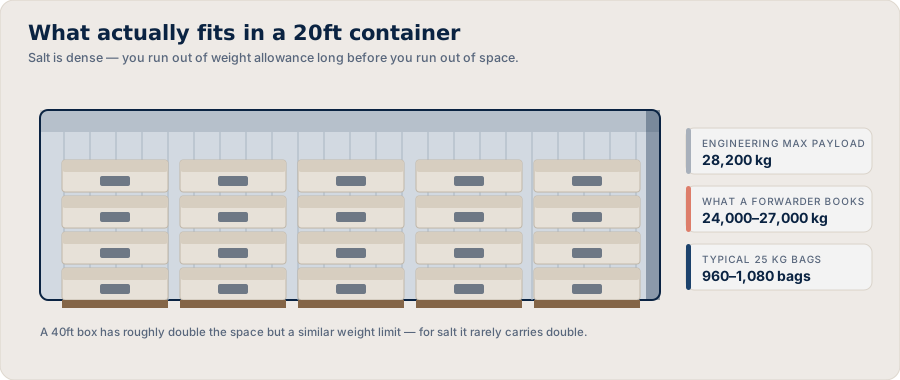
A 20ft container has a tare of roughly 2,300 kg, a maximum payload near 28,200 kg and a maximum gross of 30,480 kg. Those are engineering limits; the bookable figure is lower, typically 24–27 MT net of bagged, palletised salt, because pallets eat space and destination road-weight rules cap what a truck may legally pull. Many US states cap gross vehicle weight around 80,000 lb, roughly 36 MT, tractor and chassis included.
Below 100 kg, courier. Between 100 and 500 kg, expect sea to win. Above 500 kg, LCL. Above about 15 MT, price a full 20ft container even if you think you do not need one buying more salt often costs less in total.
Karachi to North America: what the calendar really looks like
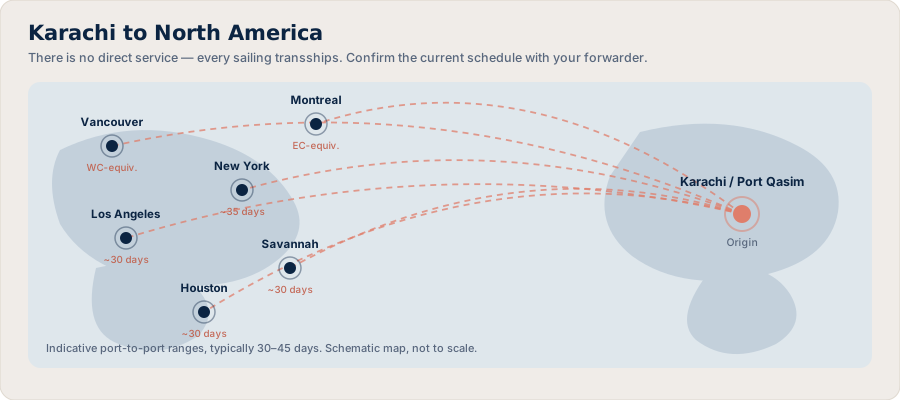
Every container from Karachi to a US port is transshipped no direct service. A hub call, a wait for the connecting vessel, then a second leg.
| Lane | Indicative port-to-port average | Plan on |
|---|---|---|
| Karachi → New York | ~35 days | 30–45 days port to port 40–45 days door to door |
| Karachi → Los Angeles | ~30 days | |
| Karachi → Houston | ~30 days | |
| Karachi → Savannah | ~30 days |
Averages from freight forwarder transit data indicative, not a schedule. Confirm with your forwarder at booking; a change of transshipment hub moves the number by a week either way.
We found no reliable published transit data for Karachi to Canadian ports, so we are not inventing one. As a working assumption, Vancouver is generally comparable to the US West Coast, and Montreal or Halifax comparable to or slightly longer than the US East Coast. Get the real figure from your forwarder before you promise a date.
The document set, and the one certificate nobody needs
A salt shipment is not a complicated entry. The list is short and barely changes between the USA and Canada. What changes is who prepares each piece.
- Commercial invoice. Incoterm, port, HS code, net and gross weights, origin.
- Packing list. Bag and pallet count, net and gross weight per pallet, container and seal numbers.
- Ocean bill of lading. Originals couriered, or a telex release. Agree which before the vessel sails; chasing originals across two continents while a box sits on demurrage is expensive.
- Certificate of origin. From a chamber of commerce in Pakistan.
- Certificate of analysis / health certificate. Lot-specific, on laboratory letterhead, matching the batch numbers on your bags.
- ISPM-15 certificate or mark. Only where wooden pallets are used.
- FDA Prior Notice confirmation number. US-bound only, before arrival.
- Insurance certificate. Under CIF, where the seller buys the cover.
Phytosanitary certificates certify plant health. Himalayan salt is mined mineral rock no plant material, nothing to certify. A supplier who offers one has misread their own product, which tells you something about the rest of their paperwork.
Who does what
Nothing in the right-hand column can be delegated to a supplier, however much you would like it to be.
| The exporter handles | You must handle yourself |
|---|---|
| Production, screening, packing, palletisation | Appointing a customs broker |
| Maintaining the FDA facility registration | FSVP plan (USA), or PCP and SFC licence (Canada) |
| COA per lot, HACCP plan, audit records | Importer of record duties, bond, customs entry |
| Invoice, packing list, certificate of origin | FDA Prior Notice filing, via your broker |
| Inland haulage and export clearance in Pakistan | Retail label compliance, iodide statement included |
| Ocean booking and freight under CFR, CIF or DDP | Destination clearance and devanning under FOB |
FDA registration number, a recent COA, the HACCP plan summary. If any takes more than two working days to produce, that is your answer about how the shipment will go.
Duty, FDA, and the labelling line that catches everyone
Salt is one of the easier foods to bring into the United States: duty is zero, the entry routine. Importers get hurt in two places FSVP, and the iodide statement on retail packs.
Classification and duty
Himalayan rock salt sits under HTS heading 2501; the US subheading is 2501.00.0000. The General rate Column 1, the MFN rate applying to Pakistan is Free. The 30% some tariff databases show is the Column 2 rate for a short list of non-NTR countries and does not apply here.
Check hts.usitc.gov before every shipment anyway. Section 301, Section 232 and IEEPA-type actions can change treatment independently of the base rate.
No FTA, no duty saving
Pakistan has no US free trade agreement and does not need one here: the MFN duty is already zero, so a preference programme has nothing to reduce. Worth saying plainly, because it is a common overpromise. GSP or FTA paperwork that will "save you the duty" on salt saves nothing.
| Requirement | Who holds it | Timing |
|---|---|---|
| FDA foreign food facility registration | The foreign facility the exporter | Biennial, 1 October to 31 December of even-numbered years |
| FDA Prior Notice | Each shipment, normally the importer's broker or agent | Before arrival |
| FSVP Foreign Supplier Verification Program | The US importer of record. Not the exporter | Written plan before importing, kept current |
| Retail labelling 21 CFR 100.155 and 101.9 | Whoever puts the product on shelf | Before the packs are printed |
FSVP is yours. We can only help.
Under the Foreign Supplier Verification Program the US importer of record must hold a written plan verifying the foreign supplier. There is no version where the exporter does it for you the regulation names the importer. We supply the evidence it rests on: HACCP plan, COAs, audit records, facility registration.
The iodide statement, in full
21 CFR 100.155 requires salt sold at retail without added iodide to carry the statement "This salt does not supply iodide, a necessary nutrient" immediately after the product name, in type at least as large as the net quantity declaration. Iodised salt carries the mirror statement: "This salt supplies iodide, a necessary nutrient". Nutrition Facts panel per 21 CFR 101.9. Packages under half an ounce are exempt.
Pink salt has no meaningful natural iodine, so the first statement applies to nearly every pack we ship. Build it into artwork on day one.
CFIA licensing, and the eight characters that stop a shipment
Canada is where most exporter websites go quiet. Three things govern a food import here, and all three sit with the Canadian importer.
1. A Safe Food for Canadians licence
Issued by the CFIA, held by the Canadian importer of record, covering the "Importing food" activity and the relevant commodity. A licence for a different activity or commodity group does not cover this shipment.
2. A Preventive Control Plan
The PCP is a precondition of licensing, not an extra you produce if asked. Build it before you apply.
3. The licence number declared correctly to CBSA
It must be declared in the correct 8-character format set out in CBSA Customs Notice 24-03. Not a formality: a shipment arriving without a valid, correctly declared licence number can be denied entry, and a denied entry on food is slow and expensive to unwind.
Classification decides which commodity the licence must cover, and for a mined mineral food ingredient that is not always intuitive. Run your product through CFIA's licensing interactive tool before you apply.
An FDA registration and an FSVP plan buy you nothing at the Canadian border, and a CFIA licence nothing at a US port. Separate regimes, separate holders. Supply both markets and you run two compliance files.
What we provide for Canadian buyers
- Lot-specific certificate of analysisEvery shipment
- HACCP plan and process descriptionOn request
- Facility audit recordsOn request
- Specification sheet for your PCP fileIncluded
- Your SFC licence and PCPYours to hold
We are an exporter, not a Canadian regulatory consultant but your consultant gets whatever they ask for within a working day.
Who pays, who carries the risk, and why FOB and DDP quotes are not comparable
An Incoterm answers two questions who pays for each leg, and where the risk of loss passes. They are not the same question, and they do not always change at the same moment.
| Term | Seller pays up to | Risk passes at | Suits |
|---|---|---|---|
| EXW Jhelum | Nothing beyond making goods available at the plant | The plant gate | Buyers with their own agent in Pakistan |
| FOB Karachi / Port Qasim | Inland haulage, export clearance, loading on board | On board the vessel | The default for containerised salt |
| CFR destination port | Ocean freight to the named port | On board at Karachi freight paid, risk already yours | Buyers holding their own cargo cover |
| CIF destination port | Ocean freight plus marine insurance | On board at Karachi, insurance in your favour | First-time buyers, letter of credit deals |
| DDP your door | Everything freight, duty, clearance, delivery | Your door | Buyers with no broker relationship |
On a 25 MT container the gap between the two covers ocean freight, terminal handling, brokerage, drayage and unloading thousands of dollars of real cost. Put every quote on the same term before you compare a cent.
Under both, the seller pays ocean freight but risk passes on board at Karachi. If the box goes over the side mid-ocean, the freight was the seller's cost and the loss is yours. Under CIF you have insurance in your name; under CFR you need your own cover.
Enquiry to warehouse, stage by stage
Calendar days, not working days and realistic rather than optimistic. The supplier who promises the optimistic version goes quiet in week six.
| Stage | 25 kg by courier | 500 kg LCL | 20ft FCL, 25 MT |
|---|---|---|---|
| Enquiry to written quote | 1–2 | 1–2 | 1–2 |
| Proforma invoice, payment cleared | 1–2 | 2–3 | 2–4 |
| Production, screening, packing, documents | 2–3 | 5–8 | 10–18 |
| Inland haulage to Karachi / courier pickup | 1–2 | 2–3 | 3–4 |
| Export clearance, consolidation, vessel cut-off | included above | 4–7 | 3–6 |
| Main transit | 3–6 | 30–45 | 30–45 |
| Deconsolidation at destination CFS | — | 3–7 | — |
| Customs entry and FDA or CFIA release | 1–2 | 1–3 | 2–5 |
| Drayage to warehouse and devanning | included above | 2–4 | 2–4 |
| Total, enquiry to warehouse | 9–17 days | 50–82 days | 53–88 days |
Read the top of the table, not the bottom
The stages you control are the first three. Paying the proforma two days sooner moves the whole chain two days; missing a vessel cut-off by six hours costs a week. Nobody makes up time in ocean transit. For a first container, add licensing and broker onboarding and budget three months.
Five mistakes first-time salt importers make
All five are recoverable. All five cost money nobody needed to spend.
1. Comparing quotes across different Incoterms
The most expensive one, and the most common. A buyer collects four quotes, picks the lowest, and finds out at the destination port that it was EXW and the one they rejected was DDP. Freight, brokerage, drayage and unloading were all still owed. Normalise to one term first.
2. Air-freighting dense cargo
Air runs roughly five to eight times the sea rate, billed on chargeable weight, and salt has almost no air in it. A 500 kg air shipment can cost more in freight than the salt is worth twice over. A stopped line justifies it. "We did not plan ahead" does not.
3. Not appointing a customs broker before the vessel sails
Appoint the broker when you sign the proforma, not when the arrival notice lands. They need your importer of record details, bond, FDA registration and product data on file before they can file anything, and that onboarding takes days you do not have once the box is on the water. We have watched containers run up demurrage at well over $150 a day for want of a signed power of attorney.
4. Assuming a 40ft container carries twice a 20ft
It does not, and for salt it is not close. Weight is the binding constraint, and road-weight limits at destination bind before the container's own rating does. Price two 20ft boxes against one 40ft.
5. Forgetting the iodide statement on retail labels
This one hurts because it lands after everything else went right. The container clears, the pallets reach the warehouse, and QA notices the packs carry no 21 CFR 100.155 statement. Now you are re-labelling tens of thousands of units by hand. Have the artwork checked before you print, and treat the type size rule as seriously as the wording.
Agree the bill of lading release method in writing at order stage. Originals or telex release either is fine; both sides knowing which is what matters.
Import questions we answer every week
Heading 2501; for US entries, subheading 2501.00.0000, General (Column 1 / MFN) rate Free. A lookup tool showing 30% is giving you the Column 2 rate for non-NTR countries. Verify at hts.usitc.gov before each shipment Section 301, 232 and IEEPA-type actions can change treatment independently of the base rate.
No approval as such, but three things apply: a current FDA facility registration, renewed biennially between 1 October and 31 December of even-numbered years; Prior Notice filed before each shipment arrives; and a written FSVP plan held by you as importer of record. We supply the HACCP plan, COAs and audit records behind it the plan is legally yours.
A Safe Food for Canadians licence from CFIA, held by the Canadian importer of record, covering the "Importing food" activity and the relevant commodity, with a Preventive Control Plan as a precondition. The number must be declared to CBSA in the 8-character format per Customs Notice 24-03 get it wrong and the shipment can be denied entry.
Plan on 30–45 days port to port, 40–45 door to door. Every sailing is transshipped. Indicative averages: around 35 days to New York, around 30 to Los Angeles, Houston and Savannah. For Canada we have no reliable published figures Vancouver is broadly US West Coast, Montreal or Halifax East Coast or slightly longer. Confirm with your forwarder.
No. Those cover plant products; salt is a mined mineral, so there is nothing to certify, and a supplier offering one is confused about their own product. What can apply is an ISPM-15 mark for wooden pallets packaging, not product.
No there is nothing to reduce. Pakistan has no US free trade agreement and the MFN duty is already Free, so preference paperwork against a zero-rated line saves exactly zero dollars.
Send us a spec — we quote within one working day
Tell us the grade, grain size, packing and destination port. You get a written quotation, a specification sheet, and a sample on its way the same week. Trial orders start at 25 kg.