Industrial & de-icing salt, sold by specification rather than by story
Water softener, swimming pool, road de-icing, hide curing, textile dyeing, chlor-alkali feedstock and drilling mud grades. Packed in 25 kg or 50 kg PP bags and 1,000–1,250 kg FIBC bulk bags, from 5 metric tons upward.
Eight grades, and the one number that matters in each
Industrial salt is not one product with a volume discount. Each application cares about a different property, and buyers get into trouble ordering on NaCl percentage alone the only figure most quotations bother to print. Here is what actually governs, use by use.
Water softener salt 98%+ NaCl, insolubles under 0.3%
Purity matters, insolubles matter more: whatever will not dissolve clogs the brine well and fouls the resin bed, and a fouled bed loses capacity. Granular 2–5 mm or compressed pellet. Pellet costs more and earns it in cabinet units.
Swimming pool salt 99%+ NaCl, low iron, low insolubles
Iron is the whole conversation. It oxidises in chlorinated water and stains plaster, grout and fibreglass a rust colour that costs real money to remove. Fine to medium grain, 0.5–2.0 mm, for fast dissolve. Our tightest industrial specification.
De-icing and road salt purity is not the point
Grain distribution and price decide this one. De-icing salt runs 92–97% NaCl and no highway depot cares, because the insolubles wash into the drain. They want a graded 1–10 mm spread that neither blows off as dust nor bounces as oversize, at a cost per ton somebody can defend to a council. Read the next section before ordering this grade from Pakistan.
Tannery and hide curing salt coarse, graded, low iron
Curing salt has to penetrate a wet salted hide evenly, so the grain spread does the work. Too fine and it crusts; too coarse and it sits in pockets while the hide spoils underneath. A controlled 1–4 mm distribution, not a single cut, with iron held low a stained hide is a downgraded hide.
Textile and dyeing salt consistency, batch to batch
Dyers do not need the highest purity on the market. They need the same purity in March they had in January, because exhaust dyeing recipes are calibrated to a fixed electrolyte load and a two-point NaCl swing shifts shade. We hold a narrower window than the headline figure and print the batch number on the bag.
Chlor-alkali and chemical feedstock the impurities, not the salt
Membrane cell operators read calcium, magnesium and sulphate first, NaCl second. Calcium and magnesium poison the membrane; sulphate builds in the loop and forces a purge. Send your brine limits and we will say whether our seam meets them untreated. For some cells it does not.
Oil and gas drilling mud salt
Weights and saturates water-based muds and inhibits clay swelling through salt sections. Buyers want a predictable dissolution rate and low insolubles, which otherwise load the solids-control kit. Fine to medium grain, bagged at 25 kg for rig-floor handling.
Soap and detergent salting-out
High volume, price sensitive. Low calcium and magnesium is the requirement they form insoluble soaps and cloud the bar plus enough consistency that the kettle behaves the same each batch. One of the lines where we are genuinely competitive into the Gulf and East Africa.

"Industrial salt" means eight different things. Send the NaCl minimum, insolubles maximum, moisture, iron limit and sieve range your process runs to; we will quote against it or tell you we cannot hit it. Sieve analysis free with any quote.
When you should buy domestic instead of buying from us
The section our competitors leave out. If you are buying road de-icing salt by the thousand tons for a North American municipality, we are probably not your cheapest option, and you should know that before you spend three weeks on an RFQ.
Why we lose on North American road salt
Three reasons, none of which we can argue away. Domestic mined salt from the Great Lakes and Gulf basins sits close to the demand, so its freight leg is a barge or a truck, not an ocean voyage. Solar salt from Chile, Mexico and Egypt arrives in vessel quantities at a cost per ton a bagged container from Karachi cannot touch. And demand is violently seasonal: everybody wants de-icing salt in Q4 and Q1, exactly when Asia–US freight rates and port congestion peak. You would be buying the year's most expensive freight for the catalogue's cheapest commodity.
If cost per ton is your only criterion for municipal de-icing, buy domestic. We say so on the first call, not the fourth.
Where our salt does make commercial sense
- Markets closer to Pakistan. The Gulf, East Africa, South and Southeast Asia, parts of Eastern Europe. Short freight leg, competitive delivered.
- Filling container weight. If you already import our edible or lamp lines and the box cubes out before it weighs out, industrial salt underneath is close to free tonnage.
- Small quantities. Buyers needing 5–40 MT rarely get attention or sensible pricing from a domestic producer geared to unit trains.
- Purity-led grades. Tannery, textile dyeing, pool and softener salt, where batch-to-batch consistency and a real lab report outrank four dollars a ton.
- Pink de-icing salt for premium retail. Bagged and coloured, sold through garden centres and hardware chains as an eco or design-led line. The colour is the value; price per ton barely enters it.
Sodium chloride stops being useful on a road at around −9 °C (15 °F). Below that, melting slows to irrelevance regardless of application rate, and you need calcium or magnesium chloride blended in or applied as a liquid pre-wet. No rock salt, pink or otherwise, changes that. A supplier promising performance at −20 °C is describing a blend without saying so.
Typical analysis by application
Typical ranges, not a guarantee for your lot. Every consignment ships with its own certificate of analysis carrying the batch number printed on the bags.
| Grade | NaCl (dry) | Moisture | Insolubles | Iron (Fe) | Typical grain |
|---|---|---|---|---|---|
| Water softener | 98.0–99.2% | ≤ 0.5% | ≤ 0.3% | ≤ 20 mg/kg | 2–5 mm granular or pellet |
| Swimming pool | ≥ 99.0% | ≤ 0.3% | ≤ 0.10% | ≤ 10 mg/kg | 0.5–2.0 mm |
| De-icing / road | 92–97% | ≤ 2.0% | ≤ 3.0% | Not specified | 1–10 mm graded |
| Tannery / hide curing | 97.0–98.5% | ≤ 1.0% | ≤ 1.0% | ≤ 15 mg/kg | 1–4 mm graded spread |
| Textile & dyeing | 98.0–99.0% | ≤ 0.5% | ≤ 0.5% | ≤ 20 mg/kg | 0.3–1.5 mm |
| Chlor-alkali feedstock | ≥ 98.5% | ≤ 1.5% | ≤ 0.5% | Ca+Mg ≤ 0.30%, SO4 ≤ 0.40% | 1–5 mm |
| Drilling mud | ≥ 97.0% | ≤ 1.0% | ≤ 1.0% | ≤ 30 mg/kg | 0.2–2.0 mm |
| Soap & detergent | ≥ 98.0% | ≤ 0.5% | ≤ 0.4% | Ca+Mg ≤ 0.40% | 0.3–2.0 mm |
Tighter limits are available on most lines through extra washing and screening, at a cost we quote openly. See quality & certifications for the laboratories we use.
Industrial salt is a freight business wearing a mining costume
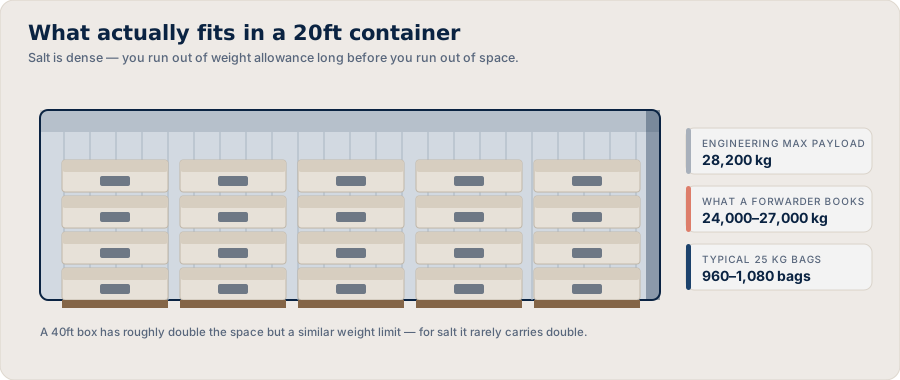
Salt is dense, so a container weighs out long before it cubes out. A 20ft box has an engineering payload near 28.2 MT, but after pallets, bag stacking and destination road-weight limits, forwarders book roughly 24 to 27 metric tons net of bagged product. A 40ft box almost never carries double you hit the weight ceiling first.
That one fact makes most FOB comparisons meaningless. At $0.11/kg FOB, the salt in a full 20ft container is worth around $2,900; ocean freight, terminal handling and inland delivery on the same box can exceed that. A supplier quoting $0.09 against our $0.11 is offering you roughly $500 on a shipment where freight is the deciding variable. Ask for CFR or DDP, or for FOB plus a named freight quote to your port. An FOB number alone tells you very little.
| Packing | Net weight | Notes |
|---|---|---|
| PP bag, laminated | 25 kg | Default for softener, pool, tannery and drilling grades. Easiest for manual handling |
| PP bag, heavy duty | 50 kg | Lower packing cost per ton. Common for de-icing and soap grades in markets with labour available |
| FIBC bulk bag | 1,000–1,250 kg | Cheapest per ton by a clear margin. Four-loop, with liner if moisture is a concern. You need a forklift and a discharge frame |
| Loose bulk | Container load | Limited availability, and rarely practical for export see below |
| Retail bagged | 4–25 kg | Printed poly or laminated PP for pool, softener and pink decorative de-icing sold at retail |
Why loose bulk usually fails in containers
It needs a bulk liner at origin, a tipping chassis or vacuum unit at destination, and somewhere to put 26 tons of loose salt inside the free-time window. Moisture migrates across a four-week voyage and cakes the load against the walls. Lines charge for cleaning, and some refuse loose salt outright because it corrodes the box. Bulk bags land within a few dollars a ton of loose and avoid all of it.
What industrial buyers need that food buyers do not and vice versa
Industrial documentation is lighter than food documentation, but the difference is a classification question, and classification is decided at entry, not by what we print on the bag.
Certificate of analysis per lot on the laboratory's letterhead, commercial invoice and packing list, certificate of origin, bill of lading, and a GHS safety data sheet. Phytosanitary certificates do not apply to a mineral, though wooden pallets need ISPM 15 treatment and we mark them accordingly.
FDA food-facility registration or prior notice for genuinely non-food grades such as road de-icing or tannery salt. Nor kosher or halal certification, nutritional or allergen statements, or the iodine labelling that governs retail edible salt in the United States.
The exemption follows intended use, not our description. Salt entering the United States as human food or animal feed does require FDA prior notice, and softener and pool salt sit close enough to consumer-handled goods that some brokers classify them conservatively. If your material could be diverted to food or feed, confirm the classification and entry codes with your customs broker before shipment. Getting it wrong means a hold at the port, and a held container accrues demurrage daily. We are an exporter, not your regulatory adviser better to flag it than let you assume.
Entry procedure, Incoterms and a worked landed-cost example are on the shipping & import guide.
Indicative bands by grade and volume
Ex-works US dollars per kilogram, August 2026, for standard 25 kg or 50 kg PP bags. Bulk bags run 6–12% below the bagged figure. Freight, insurance and duty are quoted separately, and as noted above they will usually exceed the salt.
| Grade | 5–20 MT | Full 20ft container | Multi-container schedule |
|---|---|---|---|
| De-icing / road salt | $0.12–$0.17 | $0.10–$0.13 | $0.09–$0.11 |
| Soap & detergent | $0.13–$0.19 | $0.11–$0.15 | $0.10–$0.13 |
| Chlor-alkali feedstock | $0.13–$0.19 | $0.11–$0.15 | $0.10–$0.13 |
| Tannery / hide curing | $0.14–$0.20 | $0.12–$0.16 | $0.10–$0.14 |
| Drilling mud | $0.14–$0.21 | $0.12–$0.17 | $0.11–$0.14 |
| Textile & dyeing | $0.15–$0.22 | $0.13–$0.18 | $0.11–$0.15 |
| Water softener (granular) | $0.17–$0.24 | $0.14–$0.19 | $0.12–$0.16 |
| Swimming pool 99% | $0.22–$0.32 | $0.18–$0.26 | $0.16–$0.22 |
Softener pellets and pink decorative de-icing salt in printed retail bags are quoted separately, since packing dominates the cost. Full terms and payment structure are on the wholesale pricing page.
What industrial buyers ask before they commit
Usually not. Domestic mined salt sits close to the demand, and solar salt from Chile, Mexico and Egypt arrives in vessel quantities at a cost per ton a bagged container from Karachi cannot match. Add the Q4–Q1 freight and congestion spike and the arithmetic is against us. Buy domestic if cost per ton is your only criterion.
To about −9 °C, or 15 °F, in practical road conditions. The laboratory eutectic is lower, but on a real surface with traffic, wind and a finite application rate, melting slows to the point of uselessness below that. Colder than that, you need calcium or magnesium chloride, blended dry or applied as a liquid pre-wet.
5 metric tons. Under that, freight per ton makes the delivered price uncompetitive against whatever is available locally, and selling you an order you will regret costs us the repeat business. Most industrial buyers move straight to a full 20ft container at 24–27 MT.
For genuinely non-food grades road de-icing, tannery, drilling mud generally no. But the determination follows the intended use declared at entry, not our product name. Salt entering as human food or animal feed does require prior notice, and some brokers treat softener and pool salt conservatively. Confirm classification with your broker before shipment; a misclassified container sits at the port accruing demurrage.
Because it is the number one complaint in the category. Dissolved iron oxidises in chlorinated water and stains plaster, tile grout and fibreglass a rust colour that costs real money to remove. We hold pool grade at 99% NaCl minimum, iron in single-digit parts per million, insolubles under 0.1%.
Only if you can show us the discharge equipment. Loose salt needs a bulk liner at origin and a tipping chassis or vacuum unit at destination, it cakes against the container walls over a four-week voyage, and lines charge for cleaning because salt corrodes the box. FIBC bulk bags at 1,000–1,250 kg cost within a few dollars a ton of loose and remove all of that.
Send us a spec — we quote within one working day
Tell us the grade, grain size, packing and destination port. You get a written quotation, a specification sheet, and a sample on its way the same week. Trial orders start at 25 kg.