Himalayan salt grain size guide: millimetres, mesh, and which fraction you actually need
"Fine", "medium" and "coarse" are trade slang, not standards. This guide gives you the millimetre ranges, the US standard sieve mesh conversions, and the wording to put in a purchase order so that what lands on your dock matches what you thought you bought.
"Fine", "medium" and "coarse" are trade slang
Last year a buyer in Ontario came to us after two failed grinder launches. He had ordered coarse pink salt twice, from two different exporters, at what looked like the same specification. The first delivery was around 2 mm and rattled straight through his ceramic mechanisms uncut. The second was closer to 6 mm and jammed them. Both invoices said "coarse". Neither supplier had lied.
There is no binding international standard fixing what coarse salt means. Codex Alimentarius covers purity and contaminants for food-grade salt; it does not legislate grain vocabulary. ASTM and ISO publish sieve specifications, which define the measuring instrument rather than the product category. Every mine, packer and trading house draws its own lines.
The fix costs nothing. Stop ordering by adjective. Specify millimetres in the purchase order, name the sieve sizes the material will be judged against, and ask for a sieve analysis with every lot. A supplier who cannot produce one has told you something useful about how they screen.
An adjective is a marketing term. A millimetre range with a sieve reference is a contract. Write the second one into your PO and the argument never happens.
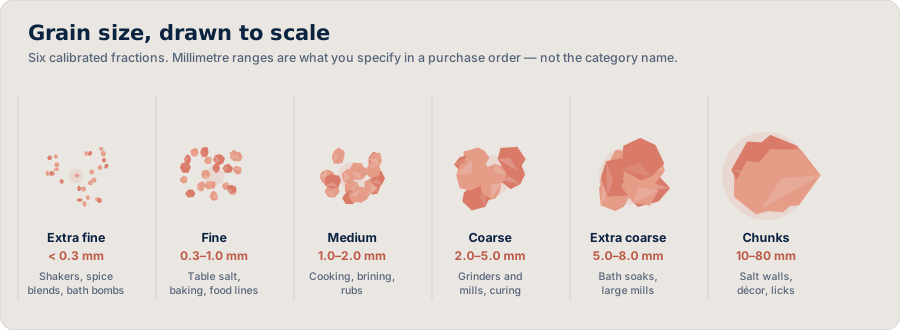
The six fractions, in millimetres
These are the ranges we screen to and publish. They are broadly conventional across the better Pakistani exporters, but treat them as our house standard rather than an industry law. Our edible pink salt page covers the food-grade specification behind each of them purity, moisture, heavy metals and packing.
| Fraction | Range | Behaves like | Main uses |
|---|---|---|---|
| Extra fine / powder | Under 0.3 mm | Table salt, icing sugar | Shakers, spice blends, bath bombs, cosmetic bases |
| Fine | 0.3–1.0 mm | Caster sugar, fine sand | Retail table salt, baking, dosing lines that meter by weight |
| Medium | 1.0–2.0 mm | Demerara sugar | Cooking, brining, visible salt in rubs and seasoning mixes |
| Coarse | 2.0–5.0 mm | Coarse gravel chippings | Grinder and mill fill, curing, finishing salt |
| Extra coarse | 5.0–8.0 mm | Small pebbles | Bath soaks, decorative jar fills, large-format mills |
| Chunks / rock | 10–80 mm | Hand-broken rock | Salt walls, display bowls, sole jars, animal use |
Note the gap between 8 mm and 10 mm. That is deliberate and it is honest: material in that band exists, but it comes off the screens in quantities too small and too irregular to promise as a stocked grade. If you need it, we hand-sort, and it costs more per kilo than either neighbour.
Mesh conversion: the table nobody publishes
Food manufacturers, laboratories and anyone writing a real quality specification work in mesh, not in marketing adjectives. Mesh number is the count of wire openings per linear inch of sieve cloth, so it runs inversely to hole size. A 100 mesh sieve has far smaller apertures than a 10 mesh sieve. This trips people up constantly a buyer asks for "higher mesh, please" meaning bigger grains and gets powder.
The apertures below are the US standard sieve series as published in ASTM E11, which is what a US or Canadian lab will use if you send them a sample. Nominal aperture is given in both millimetres and microns, because half the industry writes one and half writes the other.
| US mesh no. | Aperture (mm) | Aperture (µm) | Where it sits in salt |
|---|---|---|---|
| No. 4 | 4.75 | 4,750 | Near the top of coarse |
| No. 6 | 3.35 | 3,350 | Mid coarse |
| No. 8 | 2.36 | 2,360 | Lower coarse |
| No. 10 | 2.00 | 2,000 | Exact medium / coarse boundary |
| No. 12 | 1.70 | 1,700 | Upper medium |
| No. 14 | 1.40 | 1,400 | Mid medium |
| No. 16 | 1.18 | 1,180 | Lower medium |
| No. 20 | 0.850 | 850 | Upper fine |
| No. 25 | 0.710 | 710 | Fine |
| No. 30 | 0.600 | 600 | Mid fine the peak of most fine lots |
| No. 35 | 0.500 | 500 | Fine |
| No. 40 | 0.425 | 425 | Lower fine |
| No. 50 | 0.300 | 300 | Exact fine / extra fine boundary |
| No. 60 | 0.250 | 250 | Extra fine |
| No. 80 | 0.180 | 180 | Powder |
| No. 100 | 0.150 | 150 | Powder the usual fines cut point |
Two conveniences worth remembering. No. 18 has an aperture of exactly 1.00 mm, which lands precisely on our fine/medium boundary, so it is the natural sieve to use when you want to prove a fine lot has no medium in it. And No. 10 at 2.00 mm sits exactly on the medium/coarse line. The 5 mm top of coarse has no exact match: the nearest sieves are No. 4 at 4.75 mm and No. 3½ at 5.60 mm, so specify whichever side of 5 mm you would rather live on and say so.
How a real specification is written
Sieve language is a pair of statements: what the material passes through, and what it is caught on. "Passing 20 mesh" means the grain went through a 0.850 mm hole, so it is smaller than that. "Retained on 40 mesh" means it did not go through 0.425 mm, so it is bigger than that. Put the two together with a percentage and a tolerance and you have something enforceable.
Worked example, fine grade: Minimum 90% by weight passing US No. 18 (1.00 mm) and retained on US No. 50 (0.300 mm). Maximum 3% by weight retained on US No. 18. Maximum 5% by weight passing US No. 100 (0.150 mm). Sieve analysis per lot, ASTM E11 sieves, 500 g sample, 10 minutes mechanical shake.
That single paragraph removes almost every argument that follows a grain-size complaint. It states the target band, caps the oversize, caps the fines, and fixes the test method because a 3-minute hand shake and a 10-minute mechanical shake on the same sample will not produce the same numbers.
Particle size distribution, and why an "average" is nearly useless
A sieve analysis is physically dull and analytically powerful. A weighed sample is placed on the top of a stack of sieves arranged coarsest to finest with a solid pan at the bottom, the stack goes on a mechanical shaker for a fixed period, and then each sieve is weighed with what it caught. The result is a table of percent retained on each sieve, from which you calculate the cumulative percentage that passed each one.
| Sieve | Aperture | % retained | Cumulative % passing |
|---|---|---|---|
| No. 16 | 1.18 mm | 0.4 | 99.6 |
| No. 18 | 1.00 mm | 2.1 | 97.5 |
| No. 30 | 0.600 mm | 38.4 | 59.1 |
| No. 40 | 0.425 mm | 31.2 | 27.9 |
| No. 50 | 0.300 mm | 24.6 | 3.3 |
| No. 100 | 0.150 mm | 2.6 | 0.7 |
| Pan | — | 0.7 | — |
Read that as a real lot of fine salt. Only 2.5% of it is above 1.00 mm, so oversize is under control. Only 3.3% is below 0.300 mm, so it will not dust badly. Nearly 70% of the mass sits between 0.425 and 1.00 mm, which is a well-centred, reasonably tight lot. Against the worked specification above it passes on every clause.
Now consider why an average grain size would have told you almost nothing. Take that lot and a second one made of half 0.15 mm powder and half 1.2 mm medium. Both could report a similar mean. They are not remotely the same material. The second segregates in a hopper, dusts in the packing hall, and gives you wildly variable fill weights. Distribution is the property that matters; the mean is a summary that hides exactly the thing you needed to see.
A tight distribution flows predictably, fills consistently and pleases auditors, but it means more screening passes and more off-spec material we have to sell elsewhere, so it costs more per kilo. A loose distribution is cheaper and perfectly fine for a brine tank or a bath soak. Buy the tolerance your process actually needs, not the tightest one on the menu.
Grain size by application
Table and shaker salt
Fine, 0.3–1.0 mm, or extra fine if the shaker holes are small. The failure mode here is ordering fine at the top of the band, around 0.9 mm, and discovering it pours out of a shaker like gravel and sits on food without dissolving. If you are packing consumer shakers, ask us to centre the lot lower, nearer 0.4–0.6 mm, and specify a maximum retained on No. 30.
Grinders and mills
Coarse, 2–5 mm, and this is the fraction that generates more private-label complaints than every other issue combined. A ceramic grinder mechanism cuts by trapping a grain between a rotor and a burr. Below about 2 mm the grain is smaller than the gap and falls straight through uncut, so the customer turns the knob and gets salt but no grinding sensation, then leaves a one-star review saying the grinder is broken. Above about 5 mm the grain wedges in the throat before it reaches the burrs, and on the cheaper mechanisms that end a launch quickly. Grinder bodies vary far too much for a universal answer. Send us the model number and we will run a sample through that exact body before you commit to a production quantity we keep a shelf of common mechanisms for this.
Food manufacturing and dosing lines
Fine or medium, depending on whether the line meters by weight or by volume. Three things matter more than grain size in isolation. Flow: rounder, well-graded grain flows; angular grain with a wide spread does not. Bridging: fine material with a fines tail arches over a hopper outlet and starves the dose, usually at 2am when nobody wants to hear about it. Dust: every percentage point of sub-0.15 mm material becomes airborne at the transfer points and settles on the sealing jaws, which is where you get seal failures. If your line has a history of bridging, spec a fines cap before you spec anything else.
Brining and curing
Medium to coarse. Dissolution rate scales with surface area per unit mass, so fine salt dissolves fast and coarse dissolves slowly, and in a brine that difference is the whole point. A charcuterie maker curing a whole muscle wants the salt to release gradually and the cure to move inward at a controlled rate; fine salt dumps its load into the surface layer too quickly. For a fast-turnaround wet brine where you just want a saturated solution in a tank, use fine and save the mixing time. Match the grain to the clock, not to tradition.
Finishing salt
Coarse, 2–5 mm, occasionally extra coarse. This is a purely sensory choice. The buyer wants visible pink crystals on the plate and an audible crunch that does not disappear the instant it hits a warm steak. Colour consistency matters more here than anywhere else in the food range, because the product is looked at closely. Expect to pay for sorting.
Bath and spa
Coarse and extra coarse. Two competing considerations. In a jar on a shelf, extra coarse reads as premium big translucent chunks, obvious mineral character, a product that looks like it came out of a mountain. But it dissolves slowly in a tub, which some customers read as quality and others read as a failure. And it fills a jar with more air, so the same jar holds less product by weight. Our usual recommendation for a retail bath line is coarse at the top of its band, or a deliberate blend. See the bath and spa salt page for the grades we stock.
Bath bombs and scrubs
Extra fine for bombs, fine for body scrubs. In a bath bomb the salt has to compress cleanly and dissolve fast, and anything gritty ruins the texture. In a scrub the grain is the abrasive, so fine at the lower end gives a facial-grade product and fine at the upper end gives a foot scrub. One warning: blending oil into extra fine salt produces clumping almost immediately, because the oil bridges the particles. Formulators who blend by hand at small scale get away with it; the same recipe at 200 kg in a ribbon blender turns into a solid mass unless the mixing sequence and the oil load are worked out first.
Animal licks
Two routes. Natural licks are hand-cut blocks of solid rock the animal works the surface, and grain size is not a concept that applies. Compressed licks are pressed from a defined granular fraction, usually medium to coarse, because the press needs a particle mix that interlocks and holds without a binder. Too fine and the block is dense but crumbles at the edges; too coarse and it will not consolidate. Our animal lick page covers both formats.
Decorative fills and salt walls
Extra coarse and chunks. For a backlit wall, chunk size drives how the light diffuses: smaller material gives an even glow and larger material gives dramatic variation and shadow. Weight is the constraint nobody plans for. Salt in bulk runs over a tonne per cubic metre, so a decorative feature of any size becomes a structural question before it becomes an aesthetic one.
Bulk density, and the jar that holds less than you promised
Solid halite has a true density of roughly 2.16 g/cm³. That number is irrelevant to your packing line, because you are not filling jars with single crystals. What governs is bulk density, which counts the air between the grains and finer material packs with less void space, so it is noticeably denser in the container.
| Fraction | Typical loose bulk density | 500 ml jar holds roughly |
|---|---|---|
| Extra fine / powder | 1.25–1.45 g/cm³ | 625–725 g |
| Fine | 1.20–1.40 g/cm³ | 600–700 g |
| Medium | 1.10–1.30 g/cm³ | 550–650 g |
| Coarse | 1.00–1.20 g/cm³ | 500–600 g |
| Extra coarse | 0.95–1.15 g/cm³ | 475–575 g |
Treat these as typical trade ranges rather than guaranteed values, and confirm them on your own lot before you finalise artwork. Grain shape, moisture and how much the material settles in transit all move the figure, and a jar that has been on a pallet for six weeks is denser than one filled this morning.
The commercial trap is straightforward and expensive. A brand designs a nice 500 ml glass jar, fills it with coarse, weighs it at 540 g and prints 540 g on the label. Next season they switch the same jar to fine, which now holds 660 g, and either they underfill visibly or they quietly repack all the artwork. Run it the other way and the complaint is worse: customers who bought the fine version and then receive the extra coarse one write reviews saying they got less product, because the jar looks emptier at the same declared weight. Decide the fill weight from the density of the specific fraction you are buying, and re-check it if you ever change grade.
Take your actual empty container, fill it from the actual salt you have been sent, tap it three times on the bench the way a filling head would, level it off and weigh it. Do it three times and average. That single test is worth more than any density table, including ours.
Dust and fines
Every screened fraction contains some material below its stated floor. This is unavoidable, not a defect. Salt is brittle; grains abrade against each other in the screen house, in the bagging line, on the pallet and in the container. A lot that was clean when it left our floor will have generated fresh fines by the time it reaches yours, purely from the vibration of the journey.
As a working benchmark, we expect under 3% below the stated floor for a fine or medium lot and under 2% for coarse and above, measured at packing. If a supplier will not put a fines cap in writing, assume their number is higher than yours.
Fines matter for three practical reasons. They become airborne dust in your packing hall, which is a housekeeping and equipment problem before it is anything else salt dust is corrosive to bare steel and unkind to bearings and seal jaws. They migrate to the bottom of a container or a jar during transport, so the consumer sees a layer of powder under nice-looking crystals and assumes damage. And they accelerate caking, because fine material has far more surface area per kilo to absorb moisture and far more contact points at which to bridge.
De-dusting is a final screening pass, sometimes with an air knife, that pulls the sub-floor material out just before packing. It costs a little in yield and a little in throughput. For an industrial brine customer it is money wasted; for a retail glass-jar product where the consumer sees the contents, it is usually worth asking for. Say so at quotation stage, because it is a production step, not a switch we can flip after the bags are sewn.
Caking, moisture and what we do about it
Sodium chloride is hygroscopic. Above roughly 75% relative humidity it starts pulling water from the air; when conditions dry again that water evaporates and leaves salt bridges between grains, which is physically what a caked bag is. Cycle a pallet through a few humid days and a few dry ones and you get a solid block from material that was free-flowing when it was sealed.
Fine cakes faster than coarse, for the same surface-area reason that makes it dissolve faster. Extra fine is the most vulnerable grade we ship, and a warehouse in Florida or the Gulf Coast in August is the hardest environment we ship into. Every additional handling step that opens a liner shortens the clock.
Our controls are unglamorous and they work: moisture held low at packing, heat-sealed food-grade PE liners inside every PP bag, sealed rather than folded closures, and desiccant in the container where the destination and season justify it. On your side, the things that matter are keeping pallets off the floor and away from external walls, avoiding stacking against a roller door that opens onto humid air forty times a day, and not opening a liner until you are ready to run the material.
We do not add anti-caking agents, and it is stated on every specification sheet rather than buried. If your filling line genuinely needs free flow you have three options, in the order we would recommend them: buy a coarser fraction if the application allows it, tighten the fines cap and add de-dusting, or ask us to quote a treated product as a separate, clearly declared item with the additive named on the documents. What we will not do is add one quietly, because that fails an audit and loses an account.
How to write a grain size spec that protects you
Copy the block below into your purchase order and fill in the brackets. It takes five minutes and it converts a vague expectation into something your supplier is contractually answerable for.
GRAIN SIZE SPECIFICATION
1. Nominal range: [2.0–5.0] mm. The
category name (coarse) is descriptive
only; the millimetre range governs.
2. Sieve specification: Minimum
[90]% by weight passing US No. [3½]
([5.60] mm) and retained on US No. [10] ([2.00]
mm).
3. Oversize limit: Maximum [3]%
by weight retained on US No. [3½].
4. Fines limit: Maximum [2]% by
weight passing US No. [20] ([0.850] mm).
5. Test method: ASTM E11 test
sieves, [500] g sample, [10] minutes mechanical
shake,
results reported as percent retained per sieve
and cumulative percent passing.
6. Documentation: A sieve
analysis for the specific lot number printed on
the bags,
supplied with the shipping documents, not a
generic typical-values sheet.
7. Bulk density: Report loose
bulk density in g/cm³ per lot; declared fill
weights are set from the lot figure.
8. Retained sample: Supplier
retains a sealed [1] kg sample of each lot for
[12] months for dispute resolution.
9. Tolerance on repeat orders:
Subsequent lots to match the approved
first-article
distribution within [±5]% at each named sieve.
Clause 8 is the one buyers leave out and later wish they had included. When a grain-size dispute happens it happens two months after delivery, by which time your evidence is a mixed silo and a photograph. A sealed retained sample at both ends turns an argument into a measurement.
Clause 9 matters if you are building a brand. First-article approval is easy; the hard part is lot three looking like lot one. Naming a tolerance against the approved distribution is how you keep a product consistent across a year of shipments, and it is a reasonable thing to ask of any supplier who screens properly.
If you are not sure which fraction fits your process, order a small quantity of two or three and test them on your own equipment. A 25 kg bag of each costs less than one bad production run, and we would rather sell you three test bags now than a pallet of the wrong thing in March. Details on our small orders page, and volume bands on the pricing page.
Grain size questions we answer weekly
We screen coarse to 2.0–5.0 mm, and most established exporters sit near that. But there is no binding international standard for the word, so another supplier can legitimately call 1.5 mm coarse or 8 mm coarse and be telling the truth. Never order by name alone put the millimetre range in the purchase order and ask for a sieve analysis against it.
A 2.0–5.0 mm coarse fraction is roughly material passing a 5.60 mm sieve (No. 3½) and retained on a 2.00 mm sieve (No. 10). Mesh number runs inversely to aperture, so a bigger number means a smaller hole. Written properly the spec reads "minimum 90% passing No. 3½ and retained on No. 10".
Coarse, 2–5 mm. Below about 2 mm the grain drops through a typical ceramic mechanism uncut, so the grinder feels broken. Above about 5 mm it wedges in the throat of cheaper mechanisms and the knob locks. Grinder bodies vary enough that the only reliable test is running a sample through the exact model you intend to fill send us the model number and we will do it.
Bulk density. Fine grains pack with less air between them. Typical trade figures are around 1.2–1.4 g/cm³ for fine and around 1.0–1.2 for coarse, so a 500 ml jar might hold 650 g of fine but only 525 g of extra coarse. Confirm on your own lot before you print a fill weight on the label.
A weighed sample is shaken for a fixed time through a stack of graded test sieves, and each sieve is reweighed to give percent retained and cumulative percent passing. Ask for one on every lot, against the sieve sizes your own specification names. It tells you far more than an average grain size, because two lots with the same average can behave completely differently in a hopper.
No, and it is stated on the specification sheet. We control caking with low moisture at packing, heat-sealed food-grade PE liners, and desiccant where the destination climate warrants it. If your line genuinely needs free flow, the options are a coarser fraction, a tighter fines cap with de-dusting, or a treated product quoted separately with the additive declared on the documents.
Send us a spec — we quote within one working day
Tell us the grade, grain size, packing and destination port. You get a written quotation, a specification sheet, and a sample on its way the same week. Trial orders start at 25 kg.