What Himalayan Pink Salt Actually Costs in 2026: Mine, FOB, Landed and Shelf
A kilogram of fine edible pink salt leaves our plant at about 63 US cents and reaches a US grocery shelf at roughly $4.40. This page follows that kilogram through every hand it passes, shows what each step costs, and names who takes what — including us.
A buyer emailed us in June asking a blunt question. Why, she wanted to know, does our fine edible salt leave the plant at 63 cents a kilogram when the same salt in a printed pouch sells for eleven dollars in her local grocery? She was not accusing anyone of anything. She wanted to know where the money went, because she was thinking about packing it herself.
Nobody publishes that answer. Exporters do not, because it exposes their margin. Importers do not, because it exposes theirs. So here it is, one kilogram of fine edible pink salt followed from the seam in the Khewra range to a shelf in New Jersey, with arithmetic at every step and our own gross margin printed in a table where anyone can read it.
Every figure here is indicative for August 2026. Ex-works pricing depends on grade, grain fraction, packing format and volume the published bands on our wholesale pricing page are the reference. Freight is requoted at booking, never at enquiry, because the ocean market moves faster than any web page. Retail figures are observations from live US listings spot-checked in August 2026, and Amazon pricing in particular changes hourly. Nothing on this page is a binding offer.
- The ladder: mine head to retail shelf
- Where the money actually goes, including ours
- Why two exporters quote wildly different numbers
- What a $0.25 per kg quote really is
- Freight, the variable that dominates small orders
- Margin maths for three kinds of buyer
- What moves the price year to year
- Is there money in this?
- Questions buyers ask about price
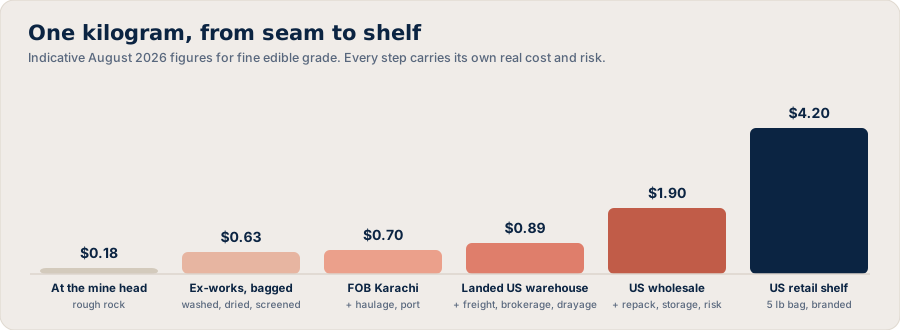
One kilogram, eight prices
Fine edible grade, 0.3–1 mm, natural colour, moving in a 20ft container of 25 metric tons. The middle column is the price of that kilogram at each point it changes hands.
| Stage | Price per kg | What was added | × ex-works |
|---|---|---|---|
| Rough rock, at the mine head | $0.06–$0.09 | Extraction, royalty, loading onto a tipper | 0.12× |
| Ex-works Jhelum, washed, dried, screened, bagged | $0.55–$0.72 | Haulage, washing, drying, screening, yield loss, bags, QC, our margin | 1.00× |
| FOB Karachi, in a loaded container | $0.70 | Bags and pallets, inland haulage, export clearance, terminal | 1.11× |
| CFR US East Coast | $0.80–$0.87 | Ocean freight, marine insurance | 1.33× |
| Landed, US warehouse | $0.85–$0.94 | Brokerage, ISF, drayage, devanning. Duty on HTS 2501 is Free. | 1.42× |
| Wholesale, plain 25 kg bag to food service | $1.55–$2.20 | Warehousing, order handling, outbound freight, credit risk | 2.5× |
| Wholesale, packed 5 lb retail bag | $1.95–$2.45 | Pouch, label, filling labour, cartons, repacker margin | 3.4× |
| Retail shelf, packed 5 lb bag | $2.90–$6.60 | Distributor and retailer margin, shelf space, shrink | 7.0× |
FOB and CFR rows are computed at the mid-band ex-works price of $0.63/kg so they reconcile with the container landed-cost example on the pricing page. Retail is an observed range: US listings for packaged pink salt clustered between roughly $6 and $15 for a 5 lb bag in August 2026. Five pounds is 2.27 kg, so that is about $2.65 to $6.60 a kilogram; strip out the occasional loss-leader and the working band is $2.90 to $6.60.
Everything that happens in Pakistan the rock, the diesel, the washing, the drying, the screening, the bags, the lab, the wages of everyone in the packing hall, and our profit adds up to about 14% of the US shelf price. Landed cost at the warehouse door is about 20%. The other 80% is earned on American soil.
The step with the largest single jump is not ours and it is not the ocean carrier's. It is the move from a 25 kg bag on a warehouse floor to a printed pouch on a shelf. That step roughly doubles the cost before anybody adds a retail margin on top of it.
Where the money actually goes, including ours
The ladder shows the prices. This shows the costs behind them. First our end, per kilogram of finished fine salt at container volume, bulk material only bags and pallets are itemised separately further down, the way they are on the pricing page.
| Our cost line | Per kg |
|---|---|
| Rough rock at the mine head 1.35 kg of feed at $0.070/kg | $0.095 |
| Haulage, mine to plant, on that same 1.35 kg | $0.024 |
| Washing, drying, fuel and power | $0.088 |
| Crushing, screening and packing-hall labour | $0.086 |
| Credit: off-spec sold into coarse, lick and industrial grades | −$0.032 |
| Lab testing, certificate of analysis, batch records | $0.016 |
| Plant overhead, depreciation, maintenance | $0.088 |
| Working-capital finance and currency cover | $0.024 |
| Rejects, reruns and a provision for claims | $0.013 |
| Factory cost, bulk fine salt | $0.402 |
| Ex-works price, mid-band | $0.630 |
| Our gross margin | $0.228 36% of ex-works |
Why there is a 1.35 in the first line
You cannot mine a grain size. You mine rock, and then you make fractions out of it. To ship a tonne of on-spec 0.3–1 mm fine, roughly 1.35 tonnes of washed rock goes across the screens. The 350 kilograms that comes off as oversize, undersize and dust is not thrown away it goes into coarse grades, compressed licks or industrial lines. But it was mined, hauled, washed and dried at fine-grade cost and it sells at $0.06 to $0.12 a kilogram. The gap lands on the kilogram you did want, and it is worth about three cents.
Tighten the specification and that number climbs fast. Ask for 0.4–0.8 mm instead of 0.3–1 mm and the feed ratio goes past 1.7. Ask for uniform deep pink with no pale or white grains and you have added hand-sorting, which is labour at every kilogram rather than a one-off setup. That is the honest reason a tighter spec costs 10 to 25% more: not opportunism, arithmetic.
Our gross margin, and what happens to it
Twenty-three cents a kilogram looks generous written down. It is the number before the business exists around it. Out of it comes the sales desk, the samples we courier free, the certification audits, the trade shows, the website you are reading, and the buyers who go quiet after we have run a full microbiological panel for them. At our volumes that is roughly ten to thirteen cents a kilogram, which leaves somewhere between $2,500 and $3,500 net on a 25 tonne container of fine salt. A container ties up cash for six to ten weeks between production and payment. It is a real business. It is not a fast one.
The rest of the chain
Now the whole stack, expressed against a 5 lb bag on a shelf at $9.99, which is $4.40 a kilogram.
| Who spends it | What on | $/kg | % of shelf |
|---|---|---|---|
| Mine | Rock and haulage to the plant | $0.119 | 2.7% |
| Us | Washing, drying, screening, labour, net of off-spec credit | $0.142 | 3.2% |
| Us | Lab, overhead, finance, claims provision | $0.141 | 3.2% |
| Us | Gross margin | $0.228 | 5.2% |
| Us | Bags, food-grade liner, palletisation | $0.030 | 0.7% |
| Hauliers, port | Jhelum to Karachi, export clearance, terminal charges | $0.041 | 0.9% |
| Carrier | Ocean freight and marine insurance | $0.135 | 3.1% |
| Broker, trucker | Brokerage, ISF, Prior Notice, drayage, devanning | $0.059 | 1.3% |
| Landed in a US warehouse | $0.895 | 20.3% | |
| Repacker | Pouch, label, carton, filling and sealing labour | $0.362 | 8.2% |
| Repacker | Warehousing, overhead, returns, margin | $0.855 | 19.4% |
| Distributor, retailer | Margin, shelf space, shrink, promotion | $2.288 | 52.0% |
| Retail shelf, 5 lb bag at $9.99 | $4.400 | 100% | |
The repacker's 19.4% is not greed. We say this as the party whose margin looks smaller in the same table. That repacker paid for a container four months before a dollar of it sold. They carried the risk that the grain was wrong, that a pallet arrived wet, that the buyer they had lined up cancelled, that the pouch film went out of stock, that a customer opened a bag and posted a photo of a dark grain. They finance inventory, they eat returns, they pay a warehouse whether the salt moves or not, and if they sell through a marketplace they hand over 15% of the retail price before touching anything. Take that risk off them and their margin looks like ours.
The line that deserves more scrutiny is the last one. Fifty-two per cent of the shelf price is distribution and retail. That is normal for a shelf-stable grocery item, and it is also the single biggest reason small brands sell direct.
Why two exporters quote wildly different numbers for the same salt
Buyers routinely send us three quotes ranging from $0.38 to $1.90 a kilogram and ask which one is honest. Usually all three are, and they are answering different questions. Five variables account for almost the entire spread.
- Volume. A 100 kg price and a container price on identical salt differ by about 2.5 times. Same seam, same screens, same bags. The paperwork, the sales time and the production changeover cost the same on both.
- Packing format. Bulk bags are cheapest per kilogram, 25 kg sacks are the standard, and retail packs cost several times more per kilogram because you are buying film, cartons, artwork and filling labour rather than salt.
- Screening and colour tolerance. Covered above. Expect 10 to 25% on top for a tight fraction or a uniform-colour request, and be suspicious of anyone who does not charge for it, because they are planning to ship you a wide fraction and hope.
- Testing scope. A standard certificate of analysis is included by any serious supplier. Full microbiological panels, extended heavy metals or per-pallet testing are chargeable, in the region of $80 to $260 per lot.
- Incoterm. The one that ruins comparisons.
A FOB Karachi quote and a DDP New Jersey quote for the identical container of identical salt can differ by more than the salt is worth. On our own numbers: FOB is about $0.70 a kilogram, and the same salt delivered duty paid to a New Jersey door is around $0.95 to $1.05 once freight, brokerage, drayage and the risk premium of us carrying all of it are inside the price. That is a spread of 25 to 35 cents on a product whose mine-head cost is 7 cents. Ask every supplier for the same term. If a quote arrives without an Incoterm on it, it is not a quote.
The second most common comparison error is grade. "Food grade" is not a grain size. A quote for extra coarse 5–8 mm and a quote for extra fine below 0.3 mm are both edible pink salt and they are separated by 15 to 20 cents a kilogram at container volume. Our edible pink salt page sets out which fraction goes with which application, and it is worth five minutes before you send an enquiry.
What a $0.25 per kg “food grade” quote really is
These land in buyer inboxes constantly, usually from a trading account on a sourcing platform, usually with a photograph lifted from someone else's website. Our own factory cost before any margin is about $0.40 a kilogram at container volume. You have just read the build-up. A quarter of a dollar does not pay for the washing, the drying and the screening, let alone the rock.
So the offer is one of four things.
- Industrial or de-icing grade with an edible label. The most common. It is real Khewra salt, but it was never washed to food standard. Insolubles run well above the 0.8% a food buyer should expect, and you find out when a customer's brine goes cloudy or a restaurant's finishing salt leaves grit on a plate.
- Genuine salt, no batch-specific testing. The COA is a scan of a document from 2019 with the batch number removed. It may even be a real report of somebody else's lot.
- A lamp quote in disguise. On the décor side the same discount usually means an uncertified cord set, which is the exact component that got 80,000 salt lamps recalled in the US in 2017. We say the same thing on the pricing page.
- An advance-fee scam. Full payment up front, a plausible bill of lading, then silence. No legitimate exporter asks a first-time buyer for 100% in advance, including us.
One: phone the laboratory. Ask for the certificate of analysis on the laboratory's own letterhead, carrying the batch number that will be printed on your bags, then call the number on the letterhead and read them the batch number. A supplier who cannot produce that in a working day does not have it. Ours will send it with the quote.
Two: dissolve a sample. Ten grams in 100 ml of warm distilled water, stirred and left to stand. Clean food-grade rock salt leaves a trace of fine sediment. Under-washed industrial material leaves a visible layer of grey-brown clay on the bottom of the glass and a cloudy column above it. It takes ten minutes and no equipment, and it has saved more buyers than any certificate wall on a website.
The corollary is worth saying too. A quote at $2.40 a kilogram for plain bulk fine salt at container volume is not premium quality. It is a trading layer, or two.
At small volumes you are not buying salt, you are buying freight
Salt is dense, cheap and heavy the worst possible combination for transport economics. Here is the same fine edible grade landed in the USA at five order sizes.
| Order size | Landed per kg | Freight as % of landed cost | Mode |
|---|---|---|---|
| 25 kg | $8.76–$14.60 | 80–88% | Courier |
| 100 kg | $4.20–$6.60 | 74–79% | Courier or air |
| 500 kg | $2.09–$3.06 | 59–64% | Air or LCL sea |
| 5 MT | $0.97–$1.34 | 30–34% | LCL sea |
| 25 MT, full 20ft | $0.82–$0.91 | 23–31% | FCL sea |
Reading this table honestly
At 25 kg the courier bill is four to seven times the value of the salt inside the box. That is not a small-order penalty invented by us it is what any carrier charges to move a dense 25 kg parcel from Punjab to a US address in five days. At container volume the whole transport bill, ocean leg plus inland haulage, port charges, drayage and devanning, comes to roughly a quarter of landed cost. The ocean leg on its own is 11 to 18%. Full breakdown on the small orders page.
Why our two published numbers differ slightly
The table above ends at $0.82–$0.91 for a container. The worked example on the pricing page says $0.845–$0.942 for the same container. Both are right: the first stops at the port, the second carries the goods to a warehouse door. The three to seven cent difference is customs brokerage, terminal handling, drayage and devanning. We would rather explain the gap than quietly harmonise two tables and hope nobody added them up.
Margin maths for three kinds of buyer
Three real shapes of business, with the arithmetic shown rather than described. Assume mid-band pricing throughout and a US East Coast entry.
(a) A small brand packing 500 g jars from a 500 kg order
Five hundred kilograms of fine grade, LCL sea, landed at $2.80 a kilogram inside the published $2.09–$3.06 band, assuming your forwarder quotes door delivery rather than port-to-port. That is $1,400 of salt on the floor. Packaging is bought at 1,000 units.
| Per 500 g jar | Cost |
|---|---|
| Salt, 0.5 kg at $2.80/kg landed | $1.40 |
| Glass jar, lid and shrink band, at 1,000 pcs | $0.62 |
| Printed label, applied | $0.11 |
| Filling, weigh-check and capping labour | $0.30 |
| Carton share (12 per case) and tape | $0.07 |
| Spill, giveaway and rejects at ~3% | $0.07 |
| Cost per sellable jar | $2.57 |
| Wholesale to a deli or farm shop | $6.00 |
| Gross margin at wholesale | $3.43 57% |
| Suggested retail on shelf | $10.95–$12.00 |
Five hundred kilograms yields about 980 sellable jars after giveaway. Sold entirely at wholesale that is $5,880 of revenue on $2,520 of cost, so roughly $3,360 gross before you have paid for a single Instagram advertisement, a market stall or an hour of your own time. Sold direct at $11.50 with the customer paying shipping, the same 980 jars gross about $8,750. That difference is the whole argument for selling direct while you are small.
The trap is time. Nine hundred and eighty jars is a lot of jars for a new brand. Budget six to twelve months of selling, and remember that the $1,400 of salt is the cheapest part of what you have committed to.
(b) An Amazon seller doing 5 lb bags from a 5 MT order
Five tonnes landed at $1.15 a kilogram mid of the published $0.97–$1.34 band is $5,750. A 5 lb bag is 2.268 kg, so 5,000 kg makes about 2,200 sellable bags after giveaway. Packing and prep is another $2,728. Total committed: $8,478.
| Per 5 lb bag | At $12.99 | At $16.99 |
|---|---|---|
| Salt, 2.268 kg at $1.15/kg landed | −$2.61 | −$2.61 |
| Printed stand-up pouch with zipper, at 2,200 pcs | −$0.44 | −$0.44 |
| Fill, seal, weigh, label | −$0.38 | −$0.38 |
| Master carton share and prep | −$0.14 | −$0.14 |
| Inbound freight to the fulfilment centre | −$0.28 | −$0.28 |
| Marketplace referral fee, 15% | −$1.95 | −$2.55 |
| FBA fulfilment, large standard, ~5.2 lb shipped weight | −$7.95 | −$7.95 |
| Storage and long-term storage share | −$0.22 | −$0.22 |
| Returns and damage allowance, 2.5% of revenue | −$0.32 | −$0.42 |
| Net per bag | −$1.30 | $2.00 |
Read that first column again. At $12.99 a price that looks entirely normal on a search results page this seller loses $1.30 on every bag they sell, and loses it faster the better the listing performs. The fulfilment fee is the killer: a heavy, cheap product is the worst thing you can put into a weight-based fee schedule. At $16.99 the same bag nets $2.00, which across 2,200 units is $4,400 for four to six months of tied-up capital and inventory risk.
Research tools estimate fees from a category average and rarely price the inbound freight, the prep, the low-inventory and placement surcharges, or the returns on a bag that can split in transit. Pull the current fee schedule yourself and use your actual shipped weight, pouch included. Amazon has revised these fees every year and the direction has been one-way. If the numbers do not work, the fix is usually a smaller pack: dropping to a 2 lb pouch cuts the fulfilment fee by roughly two dollars and often nets more per kilogram sold than the 5 lb bag does.
(c) A distributor selling 25 kg bags to food service from a container
Twenty-five tonnes landed at $0.89 a kilogram is $22,250, or $22.25 per 25 kg bag, and there are 1,000 bags on 20 pallets. Sold plain, no repacking, to restaurant suppliers and food-service distributors at $40 a bag $1.60 a kilogram, the low end of the wholesale band in the ladder.
| Line | Per container | Per 25 kg bag |
|---|---|---|
| Landed cost, 25 MT at $0.89/kg | $22,250 | $22.25 |
| Storage, 20 pallets, average 4 months at $18/pallet/month | $1,440 | $1.44 |
| Order handling, picking, pallet build | $2,200 | $2.20 |
| Outbound freight not recovered from customers | $1,800 | $1.80 |
| Breakage, short shipments, bad debt at 1.5% | $600 | $0.60 |
| Sales commission, 4% of revenue | $1,600 | $1.60 |
| Total cost | $29,890 | $29.89 |
| Revenue, 1,000 bags at $40 | $40,000 | $40.00 |
| Contribution | $10,110 | $10.11 25.3% |
That assumes every bag sells. Model 85% sell-through with the tail discounted to $26 to clear the floor and revenue drops to $37,900, contribution to about $8,100, and the margin to 21.4%. Both outcomes are a decent business. Neither is the three-hundred-per-cent story that gets told about pink salt, and the capital sits still for most of a year.
What actually moves the price
The salt moves slowly. The transport does not. A buyer who budgets for salt volatility and ignores freight volatility has the risk backwards.
| Driver | Typical annual swing | Effect on landed cost per kg |
|---|---|---|
| Ocean freight, Karachi to US | ±30% in a normal year; over 200% in a bad one | $0.03–$0.20 |
| Bunker fuel and emergency surcharges | ±20% | $0.01–$0.04 |
| PKR / USD exchange rate | Rupee weakness lowers our cost base in dollars | $0.00–$0.05 on the ex-works line |
| Monsoon, July to September | Drying capacity constrained, moisture spec harder to hold | Lead time +5–12 days, $0.01–$0.03 |
| Q4 demand: de-icing and gifting | Bookings tighten from September | $0.02–$0.06 |
| Transshipment congestion | Colombo, Salalah, Jebel Ali | Lead time +7–21 days, $0.01–$0.03 |
The monsoon one catches buyers out most often. Rock salt is dried before screening, and in a wet August the dryers become the bottleneck rather than the mine. Nothing about the salt changes, but a four-week lead time becomes six and a moisture figure that normally sits comfortably under 0.5% needs watching. If your Q4 retail programme depends on stock arriving in October, place the order in June, not August.
The freight point is the one worth a line in your business plan. A swing from $2,400 to $7,200 on a 20ft container is 19 cents a kilogram two and a half times what the rock cost at the mine head. There is no supplier negotiation that offsets that. What offsets it is booking bigger, booking earlier and holding a little more stock than feels comfortable.
Is there money in this?
Yes, conditionally, and the conditions are specific.
Yes at scale. The container distributor above clears roughly $10,000 on a shipment. Run six a year with a stable food-service customer base and it is a solid, unglamorous import business with a return that justifies the working capital.
Yes with a differentiated brand. The 500 g jar example holds 57% at wholesale and more direct. That margin exists because the customer is buying a jar they want on a kitchen counter, not a commodity.
No if you are competing on price against established listings. Look at what happened in the Amazon example. Entrenched sellers on that keyword bought their inventory at container prices, have years of reviews, and can price at a level that is loss-making for anyone landing 5 tonnes. Winning that fight requires undercutting people whose costs are lower than yours. Do not start it.
They sell a specific use rather than a generic product. Grinder refills in a fraction that actually works in a grinder mechanism. Finishing salt in a flake-adjacent coarse grade sold to restaurants, where the buyer cares about the plate and not the price per kilogram. Spa supply, where the salt is a consumable inside a service that charges by the hour. Bulk to a bakery that needs consistency more than it needs a discount. Every one of those is a narrow market with a real reason to prefer one supplier and none of them is won by being nine cents cheaper on generic “pink salt”.
The buyers we watch fail are almost always the ones who did the multiplication and stopped there. Mine cost seven cents, shelf price four dollars forty, therefore enormous margin. Everything in the middle of this page is the middle of that sum, and it is where the business actually happens.
What buyers ask us about cost
At container volume, fine edible grade is about $0.55–$0.72 per kg ex-works Jhelum, roughly $0.70 FOB Karachi, and $0.85–$0.94 landed in a US warehouse. Trial quantities of 25–100 kg run $1.55–$1.80 ex-works, and at that size the courier costs several times more than the salt. US retail packaged pink salt commonly sits between about $2.90 and $6.60 per kg on the shelf. Full bands by grade and volume are on the pricing page.
A metric ton of fine edible grade is $550–$720 ex-works at full container volume, $850–$1,100 in the 500 kg to 5 MT range, and $1,100–$1,400 for 100–500 kg lots. Landed in a US warehouse from a 25 MT container the same ton costs roughly $845–$942. Industrial and de-icing grades run from about $90 to $200 a ton ex-works, which is why relabelled industrial material is such a tempting fraud.
Because most of the shelf price is not salt. On a 5 lb bag at $9.99 the salt costs about $2.03 landed and the pouch, label, carton and filling labour add about $0.82. The remaining $7.14 is the repacker's warehousing, overheads, returns and margin plus the distributor and retailer margin. Everything that happens in Pakistan, our own profit included, is about 14% of that $9.99.
Roughly: 55–60% gross for a small brand selling packed jars at wholesale, 21–25% of revenue for a distributor moving plain 25 kg bags from a container, and anywhere from negative to about 12% for a marketplace seller shipping 5 lb bags through FBA, depending entirely on your selling price. The worked examples above show each calculation line by line, and the marketplace one is negative at prices that look completely normal on a search results page.
Almost certainly not for genuine food grade. Our factory cost before margin is about $0.40 per kg at container volume, so $0.25 does not cover washing, drying and screening. Expect industrial or de-icing material with an edible label and high insolubles, a recycled lab report with no batch number, or an advance-fee scam. Ask for the certificate of analysis on the laboratory's letterhead with your batch number on it, phone the laboratory, and dissolve 10 g in 100 ml of warm distilled water to see what settles out.
The salt itself moves within a few cents a kilogram a year. Freight is the volatile part the Karachi to US lane has swung more than 200% inside a single year, which can move landed cost by more than the mine-head price of the rock. Fuel surcharges, the rupee to dollar rate, monsoon drying capacity and Q4 congestion do the rest. We requote freight at booking rather than at enquiry for exactly this reason, and we would treat any supplier who fixes a freight number months ahead as either very brave or about to renegotiate.
Send us a spec — we quote within one working day
Tell us the grade, grain size, packing and destination port. You get a written quotation, a specification sheet, and a sample on its way the same week. Trial orders start at 25 kg.