Khewra Salt Range, Punjab, Pakistan  •  Mon–Sat, 09:00–18:00 PKT
Orders from 25 kg to full containers info@thehimalayanpinksalt.com +923352004095

A salt company that would rather show you the paperwork than the adjectives

We mine, wash, grade, test and pack Himalayan pink salt at the Khewra Salt Range in Punjab, Pakistan — and ship it to buyers who care what is actually in the bag.

Our story

Started in a trading office, ended up owning the process

The company was founded in 2009 as a small trading office in Jhelum. For the first four years we did what most salt exporters still do: buy from whoever had stock at the mine head, repack it, ship it, and hope the next lot looked like the last one.

It did not. In 2013 a European buyer rejected a container because the colour ran from pale rose to dark brick across the same pallet, and the insolubles came back at nearly double what we had quoted. We had not tested it. We had trusted a supplier who had trusted a supplier. That container cost us more than the year's profit and taught us the only lesson that has mattered since: if you do not control the seam, the wash and the lab, you do not control anything.

Since then we have worked from our own allocated seams, built a washing and grading line, put a metal detector on the packing belt, and contracted third-party testing for every lot rather than every quarter. We are not the largest exporter in Pakistan and we do not pretend to be. We are set up to be the one that a careful buyer can audit without finding a surprise.

What changed in 2021

Two things. First, we added a small-order packing cell a corner of the hall with a courier scale, printed labels and 25 kg sacks because we kept turning away exactly the customers who later grew into container buyers. Second, we started publishing our price bands, which our competitors told us was commercial suicide. Enquiry volume roughly doubled in the following year and the quality of those enquiries went up, because people who cannot afford us now self-select out before either of us wastes a week.

Inside the Khewra salt mine workings
Packing hall, JhelumEst. 2009
2009Year founded
40,000sq ft processing & packing
230+active B2B accounts
70%revenue from repeat buyers
Provenance

Where "Himalayan" pink salt actually comes from

Effectively all commercial pink salt is mined in the Salt Range of the Pothohar Plateau in Punjab, Pakistan the Khewra mine and the deposits around it, roughly 160 km from Islamabad. The Khewra mine itself has been worked since long before Pakistan existed and is operated by the state Pakistan Mineral Development Corporation using room-and-pillar extraction, leaving around half the salt in place as structural support.

The deposit belongs to the Salt Range Formation, an ancient marine evaporite bed dated to the Ediacaran and early Cambrian periods. In plain terms: it is a dried-up sea, hundreds of millions of years old, that predates the Himalayan mountains entirely. The trade name is geography-adjacent marketing from decades ago. We use it because that is what buyers search for, and we explain it because pretending otherwise is how suppliers lose accounts.

The pink comes from iron oxide traces spread unevenly through the halite. Uneven is the operative word a single seam yields pale, mid and deep pink rock within a few metres. Consistent colour in a finished pack comes from sorting and blending, not from a magic seam, and any supplier who tells you otherwise is either sorting harder than they admit or bleaching.

Quick facts, sourced

  • LocationKhewra, Jhelum District, Punjab
  • Geological periodEdiacaran – early Cambrian
  • Deposit typeMarine evaporite (halite)
  • Colour sourceIron oxide traces
  • Typical NaCl96–99%
  • IodineNot naturally present
A note on the "800 million years" claim

You will see that figure on most salt websites. The published geology puts the Salt Range Formation in the Ediacaran to early Cambrian, and precise dating has been debated in the literature. We say "hundreds of millions of years" rather than quoting a number we cannot defend to a buyer's technical team.

The plant

What happens between the rock and your pallet

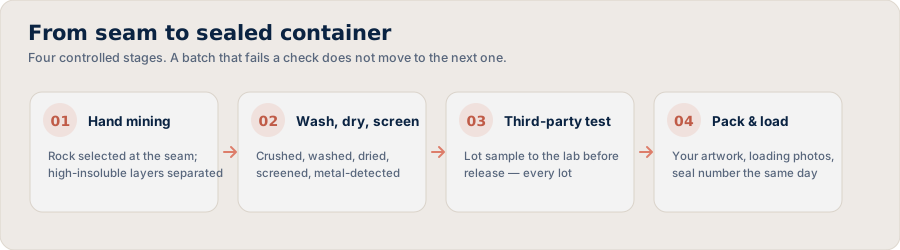
Four stages, each with a sign-off and a record. If a batch fails a check it does not move to the next stage it goes back to the wash or it goes to the industrial-grade pile.

Selection at the seam

Rock is picked by hand from our allocated seams. The darker, high-insoluble layers are separated out at this point and routed to industrial grades rather than being crushed in with food stock.

Wash, dry, screen

Crushed, washed with treated water, dried, then screened into calibrated grain fractions. A metal detector sits on the line before packing, and rejects are quarantined rather than re-fed.

Lot testing

A sample from each lot goes to a third-party laboratory for NaCl, moisture, insolubles, heavy metals and, for retail-facing lots, microbiology. Results are issued on the lab's letterhead with the batch number.

Pack & load

Food-grade liners, your artwork, palletised or floor-loaded. Loading photographs, the packing list and the container seal number go to you the same day.

Capacity, honestly stated

Around 18 containers a month across all lines, of which roughly a third is edible grade. We are a mid-sized operation. If you need 40 containers a month of a single SKU, you want a larger exporter and we will say so rather than take the order and subcontract it quietly.

What we do not do

We do not bleach salt to force uniform colour, we do not blend in cheaper solar salt to hit a price, and we do not subcontract food-grade production to third-party mills. Where we do use a partner carved lamp work and glass jars, specifically we tell you which parts and who.

The people
Four-stage process from hand mining through washing, testing and packing
Four controlled stages, each with a sign-off and a record.

You will deal with a named person, not an inbox

Every account is assigned one contact on the export desk who stays with it from first sample to repeat order. Nights and weekends included when a container is being stuffed.

Team member portrait replace with a real photograph

[Full name]

Founder & Managing Director

Third generation in the Salt Range. Handles seam allocation and anything that goes wrong at 2 a.m.

Team member portrait replace with a real photograph

[Full name]

Head of Quality

Owns the HACCP plan and the relationship with the testing lab. Has authority to stop a shipment, and uses it.

Team member portrait replace with a real photograph

[Full name]

Export Desk Americas

Your contact for US and Canadian accounts. Works US business hours two days a week so calls do not need to happen at midnight.

Team member portrait replace with a real photograph

[Full name]

Production Manager

Runs the wash line, the screens and the packing hall. Signs off every lot before it is released to loading.

Replace the four cards above with real names, titles, photographs and LinkedIn links before launch. Not one competitor site reviewed during research had verifiable named staff doing it properly is a genuine trust advantage, and doing it with stock photos destroys one.

Where we draw the line

Claims we will not put on a label, even if you ask

A large share of pink salt marketing rests on health claims that the evidence does not support. We will supply you a clean, tested, well-documented product and we will help you build a spec sheet your own QA team can sign. What we will not do is put the following on packaging we produce:

  • "84 trace minerals" as a health benefit. The trace elements are real but sit far below one percent in total, at concentrations with no meaningful nutritional effect. The count itself is not measured to any standardised method.
  • "Healthier than table salt." Sodium is sodium. Pink salt also supplies no iodine unless it is deliberately fortified, which for the iodine-deficiency purpose makes it nutritionally weaker than iodised table salt, not stronger.
  • Detox, pH balancing, weight loss, or any disease claim. These attract regulatory attention in the US, and there is a live pattern of enforcement against exactly this language.
  • Air purification claims for lamps. A salt lamp is a beautiful lamp. There is no good evidence it cleans the air in a room, and saying so on a carton is a liability we will not print.

None of this stops anyone selling pink salt well. Texture, grain, colour, provenance, mineral composition as a fact rather than a benefit, culinary use, and the story of a 500-million-year-old sea are all true and all sell. We would rather help you write that.

Why this is on our About page

Because it is a filter. If it puts you off, we would have argued about artwork three weeks into a private-label project anyway. If it reassures you, you are the kind of buyer we keep.

Responsibility

The part of the industry nobody writes about

Salt mining in the Salt Range is labour-intensive and the sector has a mixed record on working conditions. We are not going to claim a spotless supply chain we cannot audit end to end. What we can state and evidence:

  • Direct employees[number] permanent, [number] seasonal
  • WagesAbove provincial minimum, paid monthly
  • Child labourProhibited; age verified on hiring
  • PPEProvided and replaced at company cost
  • Buyer auditsWelcome, unannounced included

If you are a retailer with a social-compliance programme, tell us which scheme you work to and we will tell you honestly whether we currently meet it or what it would take.

Wash line and packing floor
Wash line, Jhelum plantPhoto to be supplied

Send us a spec — we quote within one working day

Tell us the grade, grain size, packing and destination port. You get a written quotation, a specification sheet, and a sample on its way the same week. Trial orders start at 25 kg.