Himalayan salt bricks, tiles and wall panels — with the coverage worked out before you order
Four stock sizes plus custom cuts, supplied by the pallet and by the container to salt room builders, spa contractors and wellness franchises across the US and Canada. We publish weights, coverage tables and a breakage allowance, because the quantity is where these projects go wrong.
Four stock sizes, and honest weights for each
Almost every salt room in North America is built from one of four pieces. Weights are calculated from a halite density of roughly 2.1–2.2 g/cm³ and checked against pallet weigh tickets. Treat them as approximate: these are hand-cut natural blocks and no two are identical.
8 × 4 × 2 inch brick 203 × 102 × 51 mm
The workhorse, roughly 2.2–2.3 kg a piece, about 5 lb. What a commercial salt cave wall is built from, and the size you want for a deep, low glow rather than a bright panel.
8 × 4 × 1 inch tile 203 × 102 × 25 mm
Same face, half the thickness, roughly 1.1–1.15 kg. Half the freight weight for identical coverage, better light transmission, and the sensible choice for a dry sauna or a light partition.
12 × 8 × 1 inch panel 305 × 203 × 25 mm
About 3.3–3.5 kg. Covers ground fast, fewer joints, reads architectural rather than rustic. Yield from the block is lower, and large thin pieces are the most fragile thing we ship.
6 × 3 × 1 inch small tile 152 × 76 × 25 mm
Roughly 0.62–0.65 kg. For curved walls, columns and reception fronts. More joints and more site labour, far less waste on a radius.
Custom cuts
Thickness 15–100 mm, chamfered or bullnosed edges, tapers for a curved cave wall, drilled pieces for fixings. Minimum 500 pieces on a custom profile. Send a dimensioned drawing and we will confirm the yield before quoting.
Give us the wall dimensions in feet or metres, the opening sizes, and whether it is backlit. We will return a piece count with the waste allowance already in it, a pallet plan and a weight for your structural engineer. That service is free and it takes us about a day.
The calculator most suppliers make you work out yourself
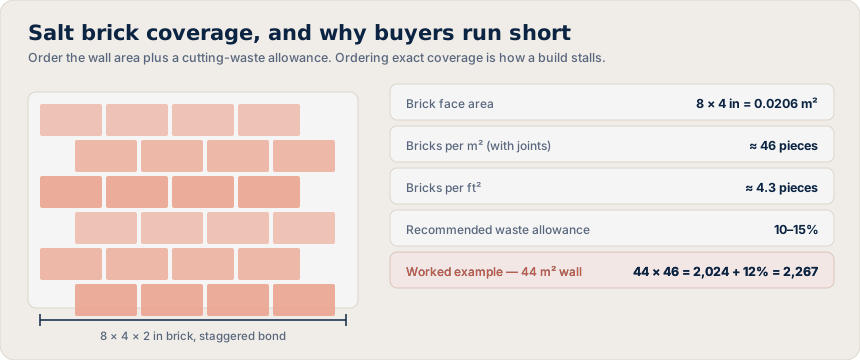
Buyers who order exact coverage always run short. Every wall has cut pieces at the reveals, corners, switches and top course, and every offcut is a piece you cannot use elsewhere. Add site handling and edge chipping and the shortfall is predictable. The second order is the expensive one: its own freight, its own minimum, and three weeks off the programme.
| Size | Butt-jointed / m² | With 3 mm joint / m² | With 3 mm joint / ft² | Order qty incl. 12% allowance | Approx. weight / piece |
|---|---|---|---|---|---|
| 8×4×2 in brick | 48.4 pcs | 46.4 pcs | 4.3 pcs | 52 / m² • 4.8 / ft² | 2.2–2.3 kg (approx. 5 lb) |
| 8×4×1 in tile | 48.4 pcs | 46.4 pcs | 4.3 pcs | 52 / m² • 4.8 / ft² | 1.10–1.15 kg (approx. 2.5 lb) |
| 12×8×1 in panel | 16.2 pcs | 15.8 pcs | 1.5 pcs | 18 / m² • 1.7 / ft² | 3.3–3.5 kg (approx. 7.5 lb) |
| 6×3×1 in small tile | 86.1 pcs | 81.3 pcs | 7.6 pcs | 91 / m² • 8.5 / ft² | 0.62–0.65 kg (approx. 1.4 lb) |
Joint allowance assumes a 3 mm adhesive bed, which is where a salt paste joint actually finishes. A 6 mm joint takes the 8×4 face down to about 44.5 pieces per square metre. The 12% shown is the middle of the 10–15% band use 15% on a curved wall or a room with many penetrations.
A 44 m² salt room wall in 8×4×2 brick
Bare coverage: 44 × 48.4 = 2,131 pieces.
With a 3 mm joint: 44 × 46.4 = 2,040 pieces.
Plus 12% waste: 2,040 × 1.12 = 2,285 pieces.
Rounded to full cartons of 8: order 2,288 pieces.
Shipped weight of salt: 2,288 × 2.25 kg = about 5,150 kg, roughly 5.7 US tons before packing. Installed dead load on the wall is around 104 kg/m², or 21 lb/ft² send that number to the engineer before anyone frames the substrate.
A contractor orders 2,040 pieces because that is what the area calls for, cuts thirty at the door reveal, breaks a dozen more on a cold morning, and is 90 short with the wall two-thirds built. The allowance costs a few hundred dollars up front and a three-week delay later.
Spare brick goes into the reception desk front, a sample board, or the year-two repair after someone drags a treatment bed into the wall. Keep it on site.
Backlit walls: thickness is the whole decision
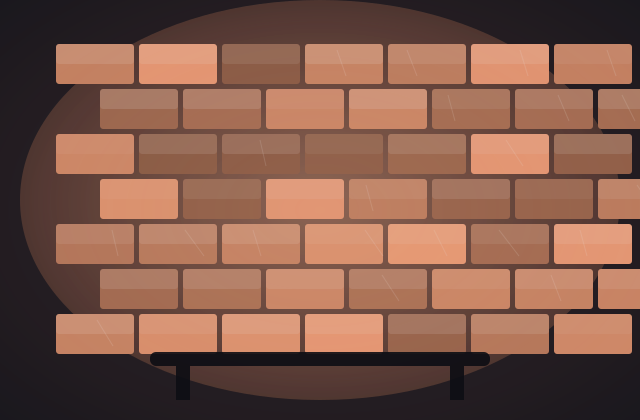
Salt is translucent, not transparent, and light falls off fast through it. A 25 mm tile lights up brightly and shows every vein and colour shift. A 50 mm brick glows warm and low, closer to embers than to a light box. Neither is better. They are different rooms.
Strip spacing follows from that. Thin tile diffuses less and shows the strip as striping unless you run it at roughly 100 mm centres behind a diffuser sheet. Thick brick does the diffusing for you, so 150–200 mm centres is fine but you need output to get through 50 mm of rock: budget 14–19 W per metre behind brick against 7–10 W behind tile.
Cavity depth is the dimension people forget at setting-out. The LED plane needs to stand off the back face far enough for the light cones to overlap: 50–75 mm behind 25 mm tile, 40–60 mm behind brick. With frame and substrate, a backlit brick wall finishes roughly 150–175 mm proud of the structural face. Draw it early or you lose it out of the room dimension.
LED, never incandescent. Filament lamps put heat into a hygroscopic material inside a mostly sealed cavity: local drying, thermal cycling, cracked pieces, and a fire risk in a void full of combustible framing. LEDs run cool enough that none of that applies. Keep the drivers outside the cavity on an accessible panel, though sealed in, they cook and fail, and someone has to dismantle a wall to change a $40 part.
Specify the strip properly. IP65 encapsulated, 24 V constant voltage over 12 V for runs beyond about 5 metres, 2200–2700 K, CRI 90 or better. Salt dust and airborne moisture corrode bare tape and exposed solder joints, and cool colour temperatures make pink salt read as muddy grey.
| 25 mm tile | 50 mm brick | |
|---|---|---|
| Light output through face | Bright, veining visible | Warm, dim, even |
| Strip centres | ~100 mm + diffuser | 150–200 mm |
| Strip output | 7–10 W / m | 14–19 W / m |
| Standoff to salt | 50–75 mm | 40–60 mm |
| Shows striping? | Yes, if under-spaced | Rarely |
| Weight on frame | ~52 kg/m² | ~104 kg/m² |
Salt is hygroscopic. The wall build-up is not optional.
Pure sodium chloride deliquesces at about 75% relative humidity at room temperature. Above that line the stone stops being a building material and starts pulling water out of the air. Everything below follows from that one number.
| Layer | What we specify | What goes wrong without it |
|---|---|---|
| Vapour control | Continuous vapour barrier or fluid-applied retarder over the structural face, laps sealed | Moisture migrates from the building into the assembly, condenses behind the salt, and the wall weeps from the bottom courses up |
| Substrate | Cement board, marine ply or an aluminium sub-frame | Plasterboard softens where brine wicks into it and the fixings let go under 104 kg/m² |
| Adhesive | Salt-specific adhesive, or a paste of ground salt in a polymer / PU adhesive so the joint colour matches | Portland cement does not bond to halite. The joint stays soluble, efflorescence pressure opens it, and chloride attacks the cement |
| Mechanical support | Stainless angles every 4–5 courses on walls over ~2 m, or a stainless pin system | Adhesive alone carries a 2 inch brick wall until it does not. Failures are progressive and start near the top |
| Humidity control | Dehumidification holding 40–55% RH, 60% absolute ceiling, running whenever the room is closed | Above 75% RH the wall dissolves. Between 60 and 75% it blooms, softens at the joints and stains the floor |
Where salt brick must not go
Steam rooms, wet rooms, showers, banyas, and any sauna where water goes on the rocks. No adhesive or sealer fixes this, and we would rather lose the order than supply a wall we know will fail. A dry Finnish sauna at 80–90 °C and under 15% RH is fine for 25 mm tiles keep them clear of the heater's radiant zone, and vent the room, because a sauna cooling overnight can drift through dew point.
Maintenance, honestly
Soft brush vacuum, no wet wipes, no cleaning chemicals. Expect light efflorescence in the first few months as the stone equilibrates; brush it off and it stops. Joints get touched up at the two or three year mark in a busy room. A wall that weeps persistently is telling you the dehumidifier is undersized or switched off at night that accounts for almost every complaint we receive, and it is a plant problem, not a stone problem.
What the wall does, and what it does not do
This part costs us business and we publish it anyway.
Two different things in a halotherapy room get constantly conflated. The decorative salt wall is what we supply: brick, tile, panel, floor salt and the light behind it. The halogenerator is a machine that grinds pharmaceutical-grade sodium chloride into a dry micronised aerosol and blows it into the room. We do not make or sell halogenerators. They are the only part of a salt room that puts salt into the air in measurable concentrations.
A salt wall does not aerosolise salt. A 50 mm brick sitting at 45% relative humidity releases essentially nothing into the breathing air, and a supplier implying otherwise is describing physics that does not happen.
As for halotherapy itself, the published evidence is limited and mixed mostly small trials with short follow-up, and reviews that conclude better studies are needed rather than that the effect is established. It is not an approved treatment for any respiratory condition in the United States or Canada. We make no medical claims, and we would advise running your own marketing copy past counsel: the FTC has acted against unsubstantiated health claims in the wellness sector, and that exposure sits with the operator, not the supplier of the bricks.
What the wall genuinely delivers is enough on its own. Light, at a colour you cannot get from paint. A surface that photographs well and fills a booking page. And a real if modest acoustic benefit an irregular salt face breaks up flutter echo between parallel walls, which is part of why these rooms feel quiet. Atmosphere, light and acoustics. Sell that and you never have to defend it.
Crushed salt for the floor
Most rooms lay 50–100 mm of coarse chunk over a sealed, bunded floor at 10–40 mm grain. Finer than that packs down and reads as gravel; coarser is uncomfortable barefoot and hard to rake level.
| Laid depth | Per m² | Per ft² | Feel |
|---|---|---|---|
| 50 mm (2 in) | approx. 62 kg | approx. 5.8 kg | Minimum for visual cover; substrate shows through in traffic lanes |
| 75 mm (3 in) | approx. 94 kg | approx. 8.7 kg | The usual specification for a treatment room |
| 100 mm (4 in) | approx. 125 kg | approx. 11.6 kg | Commercial cave floors, children's play areas |
Calculated at a loose bulk density of roughly 1.25 t/m³ for 10–40 mm chunk, allowing for void space between pieces. A 12 m² floor at 75 mm takes about 1,125 kg a tonne and a bit, not the 2.5 tonnes a solid-density calculation suggests.
Rake and sieve monthly to pull out lint, hair and migrated fines. Top up about 10% of the tonnage each year to hold the depth. Plan a full replacement every two to three years in a room running commercial hours the salt does not spoil, but it discolours and compacts until it stops looking like the photographs you sold the room on.
Dense in the middle, fragile at the edges
Salt brick rarely cracks across the face in transit. It chips at the arrises, and that is what shows in a finished wall. Hence foam sheet between layers, corner protection, and cartons sized so one person can lift them without dropping them.
| Size | Pieces / carton | Carton gross | Pieces / pallet | Approx. pieces per 20ft (weight-limited) |
|---|---|---|---|---|
| 8×4×2 in brick | 8 | approx. 19 kg | 320 | 8,400–8,900 |
| 8×4×1 in tile | 16 | approx. 19 kg | 640 | 16,800–17,700 |
| 12×8×1 in panel | 6 | approx. 21 kg | 240 | 5,600–5,900 |
| 6×3×1 in small tile | 24 | approx. 16 kg | 960 | 29,900–31,500 |
Why the container never fills up
A 20ft box loads out at roughly 19–20 metric tons of palletised brick and is still about a third empty by volume. You hit the weight ceiling long before the cube, every time. Pallets are built to 700–900 kg so a standard forklift and a spa loading dock can handle them; heavier pallets ship cheaper and become a problem on arrival.
Breakage: our number, in writing
We target under 2% transit breakage on palletised brick and we credit anything above 3%, on photographs taken before the pallet is broken down and with the shrink wrap still on. Once cartons are spread across a site, nobody can tell transit damage from a dropped box.
Indicative price bands per piece
Ex-works US dollars, August 2026, standard hand-cut finish, natural colour variation accepted. Freight, insurance and duty quoted separately. Indicative rather than binding but published, which is more than you will find elsewhere in this category.
| Size | 200–999 pcs | 1,000–4,999 pcs | 5,000+ / FCL | Cost per m² at FCL rate |
|---|---|---|---|---|
| 6×3×1 in small tile | $3.60 | $3.20 | $2.80 | approx. $255 |
| 8×4×1 in tile | $4.60 | $4.05 | $3.55 | approx. $185 |
| 8×4×2 in brick | $5.40 | $4.70 | $4.10 | approx. $213 |
| 12×8×1 in panel | $7.50 | $6.60 | $5.80 | approx. $104 |
Cost per m² uses the order quantity including the 12% allowance, so it is what the wall actually costs you rather than a theoretical area rate. Crushed floor salt is priced by weight, not by the piece: roughly $0.42–$0.70 / kg depending on volume.
Small treatment room 12 m²
One 12 m² feature wall in 8×4×1 tile, 12 m² of floor at 75 mm.
- Tile: 640 pcs @ $4.60$2,944
- Floor salt: 1,125 kg @ $0.55$619
- Salt, ex-worksapprox. $3,560
Commercial salt room 44 m² of wall
44 m² in 8×4×2 brick, 20 m² of floor at 100 mm.
- Brick: 2,288 pcs @ $4.70$10,754
- Floor salt: 2,500 kg @ $0.42$1,050
- Salt, ex-worksapprox. $11,800
Neither figure includes freight, duty, framing, lighting, adhesive or labour. See the shipping and import guide for a worked landed cost, or the full pricing page for every product line.
What salt room builders ask us
An 8×4 inch face gives 48.4 pieces per square metre butt-jointed, 46.4 with a 3 mm joint, which is 4.3 per square foot. Add 10–15% and order around 52 per square metre, or 4.8 per square foot. A 12×8 panel is 15.8 before allowance, 18 after.
No, and we will decline the order. Salt deliquesces above roughly 75% RH, so in a wet space it pulls water from the air, weeps brine down the substrate and erodes. A dry sauna under 15% RH is acceptable for 25 mm tiles, clear of the heater's radiant zone. Steam, water on rocks or a shower head is out.
We make no medical claims. The wall does not aerosolise salt in any meaningful quantity that comes from a halogenerator, which we neither make nor sell. Evidence for halotherapy is limited and mixed, and it is not an approved treatment in the US or Canada. The wall contributes light, atmosphere and a modest acoustic benefit.
25 mm tile glows brightly and shows the veining, but reveals LED striping unless strips run at about 100 mm centres behind a diffuser. 50 mm brick glows warm and even at 150–200 mm centres but needs 14–19 W per metre. Many rooms use both.
Salt-specific adhesive, or a paste of ground salt in a polymer or polyurethane adhesive so the joint colour disappears. Portland cement does not bond to halite, the interface stays soluble, and efflorescence pressure opens the joint within a season or two. On 2 inch brick or a wall over about 2 metres, add stainless angles every four to five courses at 104 kg per square metre, adhesive alone is not a support strategy.
Under 2% is our target on palletised brick and we credit above 3%, on photos taken before the pallet is broken down. Chipped arrises are the usual damage, not cracked faces. Keep that separate from your own 10–15% cutting allowance, which is a quantity buffer rather than a claim against us.
Yes 15 to 100 mm thick, chamfered and bullnosed edges, tapers for curved cave walls, drilled pieces. Minimum 200 pieces on a stock order, 500 on a custom profile, since bespoke cutting ties up saw time and the offcuts do not sell. Send a dimensioned drawing.
Send us a spec — we quote within one working day
Tell us the grade, grain size, packing and destination port. You get a written quotation, a specification sheet, and a sample on its way the same week. Trial orders start at 25 kg.